Showing posts with label Climate Change. Show all posts

Monday, August 15, 2016

Adventures in the Alpine!

By: Lydia Fahrenkrug and Gary Olds, CNHP Siegele Interns

Along with the New Mexico Heritage Program and the National Park Service, CNHP recently completed two important projects as a part of GLORIA. The Global Observation Research Initiative in Alpine Environments, GLORIA, is a project designed to monitor long-term changes in alpine tundra vegetation, soils, and temperatures. This global network assesses climate change impacts on the biological richness of the planet's high mountain ecosystems, by monitoring four summits in a target region. The peaks have similar geology, climate disturbance, and land-use history, leaving vegetation differences among the summits to be driven primarily by elevation (Kuhn et al. 2014). After initial implementation, target regions are repeat sampled at least every five years.
Gary Olds in Pecos Wilderness Area. Photo taken by Lydia Fahrenkrug.
The two target regions accomplished this summer include starting a GLORIA site in Pecos Wilderness Area, New Mexico (July 5-12) and repeat sampling in Yellowstone National Park, Wyoming (July 21-27). The trip began at Santa Barbara Trailhead, where the crew backpacked into No Fish Lake, the location of base camp all week. The crew consisted of Lydia Fahrenkrug, Dustin Gannon, Gary Olds, and Claire Tortorelli from CNHP, Hannah Burnham from New Mexico Heritage Program, and Brian Jacobs, a retired NPS botanist. Each day, they summited one of the four peaks, which were Chimayosos, West Chimayosos, North Truchas Peak and No Fish Peak to complete set-up and vegetation monitoring. With great weather and a hard working team, they were able to finish the project quickly and efficiently.
Botanists Hannah Burnham and Brian Jacobs surveying plant species in Pecos Wilderness Area.  Photo by Lydia Fahrenkrug.
The Yellowstone crew included Lydia Fahrenkrug, Alyssa Meier, Dustin Gannon, and Claire Tortorelli from CNHP, and Heidi Anderson and Monica Lomahukluh from the National Parks Service. They began in Shoshone National Forest and backpacked into their camping spot, which was on the border of Yellowstone National Park. Since this was a re-sample, all of the hardware was previously put in, allowing the crew to focus on the alpine vegetation. Everyone enjoyed the wonderful views and working together to complete this project, while wildflower season was in full swing.
Dustin Gannon measuring out for a plot in Yellowstone National Park. Photo by Alyssa Meier.
These projects were successful thanks to funding from the Rocky Mountain Inventory and Monitoring Program of the National Park Service.


References
Kuhn, B., T. Talbot, and J. Stevens. 2013. Alpine vegetation composition, structure, and soils monitoring for Yellowstone National Park: 2011 Summary Report.

Friday, June 24, 2016

CNHP and Partners Receive Honorable Mention for Climate Adaptation Leadership Award

CNHP was part of a team receiving an honorable mention in the 2016 Climate Adaptation Leadership Awards for its efforts to incorporate the consideration of climate change in Colorado’s 2016 State Wildlife Action Plan. The award was announced June 7 by the National Fish, Wildlife and Plant Climate Adaptation Strategy’s Joint Implementation Working Group.

Colorado’s latest State Wildlife Action plan now includes an assessment of how key habitat types could be impacted by a changing climate, and the collaborative effort that produced the analysis has received a national award. CNHP Conservation Planning team members Michelle Fink, Karin Decker, and Lee Grunau collaborated with Department of Interior North Central Climate Science Center and Colorado Parks and Wildlife staff in a series of workshops that evaluated potential future climate scenarios for a number of key wildlife habitats. Complete modeling and assessment results are also available as a separate report on the CNHP website.
The Honorable Mention plaque for the 2016 Climate Adaptation Leadership Awards. 

Michelle Fink (CNHP), Marian Talbert (NCCSC), Andrea Ray (NOAA), Heather Yocum (NOAA), Eric Odell (CPW), and Ken Morgan (CPW) discuss habitat models during a workshop at the Resource for Advanced Modeling center at NCCSC.


Thursday, August 13, 2015

Local Film Explores Ecological Challenges On Colorado's Front Range

We are excited to share a short film created by Ryan McDonald. Ryan is a Fort Collins native and incoming freshman at Colorado Mountain College majoring in new media and film. Ryan thoughtfully explores the ecological challenges and opportunities associated with rapid population growth and development on Colorado's Front Range in his film short. CNHP wetland ecologist Jeremy Sueltenfuss is interviewed throughout the film, as well as a frequent CNHP collaborator Crystal Strouse from the City of Fort Collins Natural Areas. Ryan created the film for a senior project at Polaris High School. Click here to check it out.

The Keyhole at Devil's Backbone Open Space in Larimer County, Colorado.

Friday, June 26, 2015

Climate Trajectories for Colorado's Terrestrial Ecosystems

By Karin Decker, CNHP Ecologist

Recently we blogged about CNHP’s Conservation Planning Team evaluating the potential effects of future climate conditions on Colorado’s species and ecosystems. An important part of this work is to look at projected future conditions in comparison with recent climate patterns. The graph below shows the projected direction of change in the current location of Colorado’s major terrestrial ecosystems as described by average annual temperature and precipitation.

Projected seasonal average precipitation and mean temperature trajectories for current upland ecosystem ranges in Colorado summer by mid-century under a high radiative forcing scenario (RCP8.5).
A comparison of recent average values of climate variables with projected values for the current locations of these ecosystems in Colorado show shows seasonal differences both in the direction and amount of projected changes in temperature and precipitation. For instance, ecosystems of higher elevations (e.g., alpine tundra and spruce-fir forest) are projected to experience a greater increase in winter precipitation than those of lower elevations (e.g. sandsage and shortgrass prairie), although the amount of warming is similar for all elevations. Projected changes in summer precipitation are generally less than for winter, with some ecosystems seeing a slight increase and others a slight decrease.

Of course average temperature and precipitation patterns are not the whole story. The interaction of climatic conditions with other abiotic factors (e.g. soils, disturbance), life-history traits of the component species (e.g. growth form, dispersal mechanisms), and past history shapes the observed distribution of ecosystems. Because many of the characteristic species of these ecosystems are long-lived, the time lag between the onset of new climate conditions and the response of the species to those conditions, adds another level of uncertainty to projections of future distribution. Climate changes over the past few decades are probably already facilitating a gradual modification of ecosystem extent and species composition that will become more apparent by mid-century.

Monday, June 1, 2015

Climate Space: Looking Towards the Future

By Karin Decker

The Conservation Planning Team at CNHP works on a number of projects that evaluate the potential effects of future climate conditions on Colorado’s species and ecosystems. As part of this work, we need to know what current climate conditions are. Here’s a look at the current “bioclimatic envelope” for Colorado’s major terrestrial ecosystems as described by average annual temperature and precipitation.
Bioclimatic envelope as represented by annual precipitation and mean temperature for ecosystems in Colorado. Error bars represent the 10-90% range around the mean.
Desert shrubland occupies the driest bioclimatic envelope, while sandsage and shortgrass prairie are the warmest. Statewide, ponderosa pine forest, oak-shrubland and sagebrush shrubland are closely related in bioclimatic space, and show substantial overlap with the warmer and drier pinyon-juniper woodlands and semi-desert grassland. Above these warm and dry types, mixed conifer, aspen, and lodgepole forest share a mid-elevation envelope with montane grasslands. The coldest, wettest environments are occupied by alpine types, with spruce-fir forest nearby in bioclimatic space.

Although a warmer future appears certain, everything else is much more complicated!

Monday, March 3, 2014

Adapting to Climate Change by Restoring Wetlands

Climate change presents challenges and opportunities for conservation and livelihoods throughout Colorado and rather than standing by and doing nothing we present an example of a restoration strategy that benefits birds, wetlands, groundwater, ranching, and overall health of the landscape while planning for future climate change.  As temperatures rise and precipitation variation becomes even greater than today we can expect frequency and intensity of droughts to increase thus threatening our wetlands that are so important to life.  Restoring our valuable wetlands today will create resilience to a changing climate and help people and nature adapt to the future.

Through a public-private partnership in the Gunnison Basin (initiated by The Nature Conservancy) we completed a two-year pilot project of restoring wet meadow habitats within sagebrush shrublands.  Using simple and non-expensive techniques that utilize local material we raised the water table and reduced erosion by eliminating headcuts.  In less than two years we can already see the benefit of these simple structures.

Thanks go to the Gunnison Climate Working group, Upper Gunnison River Water Conservancy District, Wildlife Conservation Society, Colorado Parks and Wildlife, Rocky Mountain Bird Observatory, US Fish and Wildlife Service, Southern Rockies Landscape Conserrvation Cooperative and private donors,  Bureau of Land Management, U.S. Forest Service, Natural Resources Conservation Service, Colorado Natural Heritage Program, Western State College, Zeedyk Ecological Consulting, and The Nature Conservancy.

The following presentation was created by Strijek Design with assistance from the Colorado Natural Heritage Program.

Click to view a fullscreen presentation 

One can also view a short video of this project here.

Wednesday, October 16, 2013

Dr. Healy Hamilton Visits CSU and Fort Collins Museum of Discovery

On September 26th and 27th, Dr. Healy Hamilton came to Fort Collins to give presentations on her cutting-edge work in communicating about biodiversity, climate change, and land management.  Dr. Hamilton has a long list of accomplishments and has held many leadership roles including Director of the Center for Applied Biodiversity Informatics at the California Academy of Sciences, and co-founder of the Worldviews Network   In November she is going to become the Chief Scientist for NatureServe, and she is currently moving from her home in California to Washington DC.  So we were especially excited that she was able to visit us at CNHP and talk about our visions for the NatureServe Network of Heritage Programs and how we can work with her to achieve them.  We worked with our colleague Dr. Dana Winkelman to host her as the seminar speaker for the Fishand Wildlife Conservation Biology Department, where she talked about the fascinating work she is doing with the Worldviews Network.  

Left to right: Dr. Dana Winkelman, Unit Leader of the USGS 
Colorado Coop Unit, Dr. Healy Hamilton, 
and David G. Anderson, CNHP Director
At the FortCollins Museum of Discovery she gave a presentation for NPS staff and their partners on the planetarium dome, taking advantage of its immersive environment to “place Earth within its cosmic context and connect audiences with ecological and biodiversity issues in their backyards.”  Welcome to the NatureServe Network of Heritage Programs, Healy, and we are so excited to work with you!

Monday, October 7, 2013

Natural Resource Management Decision-Making under Climate Uncertainty: Building Social-Ecological Resilience in Southwestern Colorado

In joint collaboration with several other institutes, the Colorado Natural Heritage Program was awarded a multi-year project from the North Central Climate Science Center (part of U.S. Geological Survey): “Natural Resource Management Decision-Making under Climate Uncertainty: Building Social-Ecological Resilience in Southwestern Colorado.”  Renée Rondeau, Ecologist and Conservation Planner with the Colorado Natural Heritage Program is the CSU Principal Investigator and will be working closely with Jeffrey Morrisette and Dennis Ojima (North Central Climate Science Center), as well as University of Montana, The Nature Conservancy, Mountain Studies Institute and USGS-Fort Collins over the next few years to facilitate climate change adaptation that contributes to social-ecological resilience, ecosystem/species conservation, and sustainable human communities in Southwestern Colorado while focusing on the Gunnison Basin and the San Juan Mountains.  

Gunnison Basin landscape with East Beckwith Mountain in the background.
The group will develop a set of actionable and prioritized social/ecological adaptation strategies for vulnerable ecosystems and species based on best available science.  These adaptation strategies will incorporate the latest in climate science and must be useful and meaningful to natural resource managers and other stakeholders.  The Gunnison and San Juan Basins ownership and economies revolve around ranches and private industry that relies on natural resources, US Forest Service, US National Parks, Bureau of Land Management, and Tribal Lands, and will be integral in the success of this project.  The frameworks that are developed for this project should be applicable to other western landscapes and will help guide communities in adapting to changes associated with a changing climate.  

Thursday, February 7, 2013

New Report: Treeline Monitoring in the San Juan Basin Tundra


Mountain ecosystems, particularly alpine, are among the most vulnerable to climate change. Warming conditions are likely to cause trees and shrubs to encroach into alpine tundra habitats, which are home to many species found nowhere else.

CHNP, in cooperation with the Bureau of Land Management, U.S. Forest Service and Colorado College, began a pilot project to monitor treeline expansion in the San Juan mountains. A combination of fieldwork and spatial analysis was used to determine if the treeline on the southwest slope of Kendall Mountain had changed in the last 50 years.

Aerial imagery from 1951 and 2011 were used to establish transects perpendicular to the treeline to detect growth of new trees upslope, which would indicate an upward advancement of trees into alpine areas. The location of trees along these transects were then field verified, and a subset of trees were cored to determine their age. Additionally, the density of trees below the treeline was calculated for both time periods.

Recruitment above treeline
Results show that the treeline has not advanced significantly in the last 50 years. However, there are signs of upslope recruitment (trees between 20-50 years old above the current treeline, but not in sufficient density to form a new treeline). Should this area of new recruitment continue to fill in and become the new treeline, it will be 160 feet above the existing line. Additionally, tree density below the current treeline has increased by approximately 12% in the last 50 years. All tree cores taken demonstrated an increase in growth rate since 1996.

For more information, see the complete report. We hope to expand this pilot project to study more treelines throughout the San Juan mountains, to determine if these increases in growth rate and tree density are consistent trends that can be correlated with measured increases in average summer temperatures.

Tuesday, October 2, 2012

Volunteers needed for Gunnison Climate Adaptation Project

Join The Nature Conservancy, the Gunnison Climate Working Group, and other partners for the Gunnison Climate Adaptation Project Volunteer Days on Oct 13-14. Contact Betsy Neely (720-974-7015 or bneely@tnc.org) with questions.

Monday, March 5, 2012

New report: Climate change vulnerability assessment of the Gunnison Basin

A new report is available on our Documents and Reports page. The Gunnison Basin climate change vulnerability assessment report was a joint effort between the Colorado Natural Heritage Program, The Nature Conservancy, the University of Colorado, Boulder, and the University of Alaska, Fairbanks. The project was done for the Gunnison Climate Working Group, a partnership of public and private organizations working to build the resilience of species and ecosystems so that they continue to provide benefits to people of the Gunnison Basin.

The project identified which species and ecosystems of the Gunnison Basin, Colorado, are likely to be most at risk to projected climatic changes and why they are likely to be vulnerable. The report is intended to help natural resource managers set priorities for conservation, develop effective adaptation strategies, and build resilience in the face of climate change.

Wednesday, November 23, 2011

Cool Climate Collaboration

For those who are interested in climate data, the Center for Snow & Avalanche Studies has a nice website with data from their study area in the San Juan Mountains.  Their “near-real time mountain system monitoring data” provides a continuous picture of conditions at the alpine plots in the Senator Beck Basin area. Check out the graphs presenting seven years worth of climate data! CNHP’s Peggy Lyon worked with CSAS and Julie Crawford to produce a baseline study of the plant communities in the area that is available on the site. CSAS is also engaged in fascinating research on the effects of dust-on-snow on Colorado’s mountain snowpack.
Vegetation transect in Senator Beck Basin.

Friday, July 29, 2011

GLORIA Project: Yellowstone National Park


For the third time in the past year, volunteer pilots from Lighthawk lent a hand (and wings) to CNHP project work. The Lighthawk organization provides donated flights to conservation groups.  This July, Lighthawk volunteer pilots flew CNHP staff over alpine ridges and rugged peaks in Yellowstone National Park.  The goal of the flight was to find peaks suitable for establishing a GLORIA site within the Park.  GLORIA sites, located throughout the world, are used to monitor the effects of climate change on alpine vegetation. CNHP has partnered with the National Park Service to establish sites in Yellowstone and Grand Teton National Park.  

(Left to right) Lighthawk volunteers Richard Spencer (pilot), Polly Spencer (co-pilot) with Bernadette Kuhn (CNHP botanist) and Joe Stevens (CNHP ecologist).


Richard Spencer, Lighthawk volunteer pilot, flew CNHP staff members up the Sunlight Creek drainage, and over peaks in the Absaroka Range on the eastern boundary of the Park.  We were able to identify potential peaks for GLORIA, as well as assess snowpack along our proposed route. 

 The Absaroka Range along the eastern boundary of Yellowstone National Park.

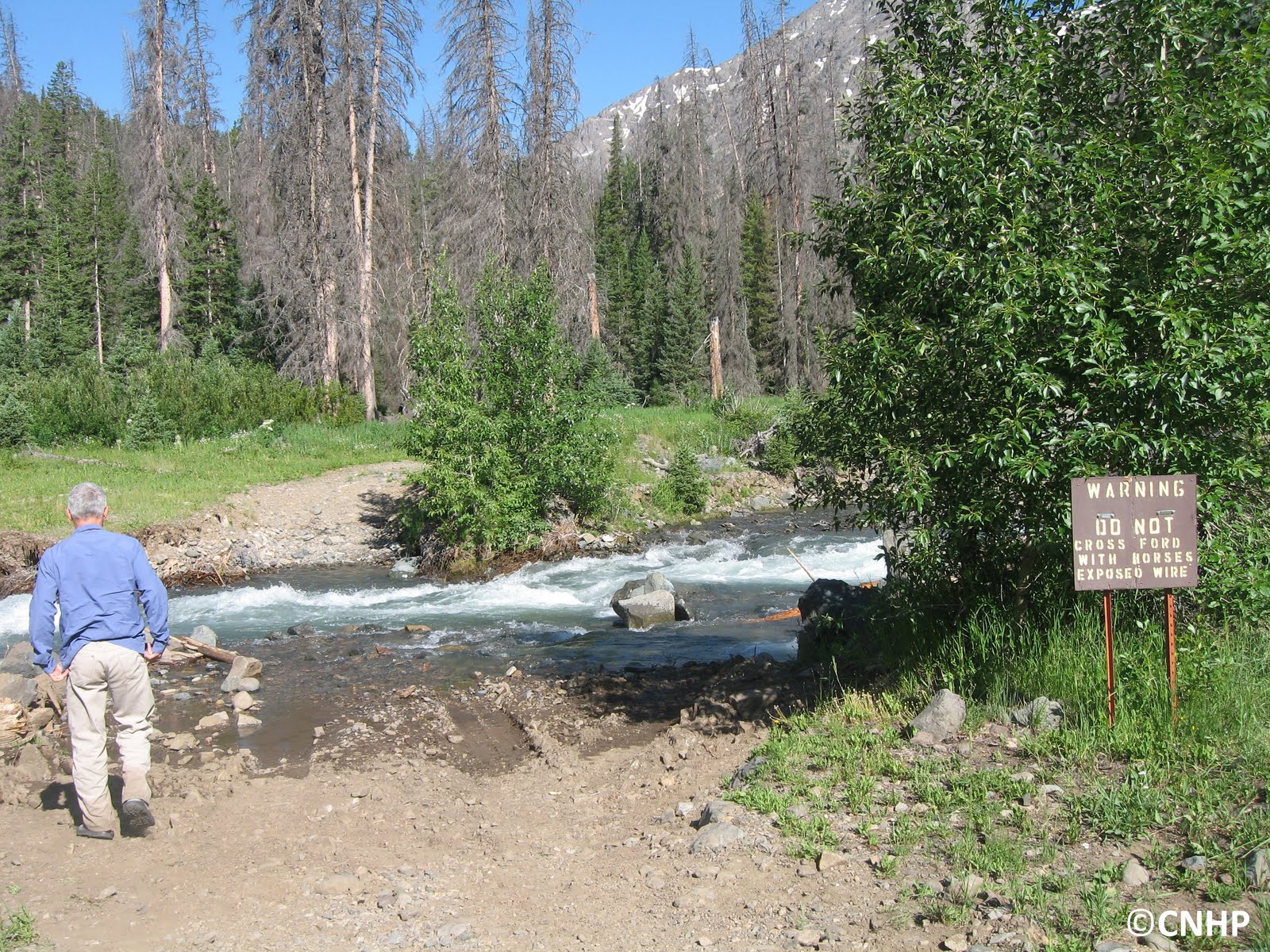
Over the last six months, we have been preparing to establish a GLORIA site in Yellowstone National Park.  Record snowpack, dangerous stream crossings, wildlife closures, and even a landslide have made access to our study area a bit challenging.  

 Uncertainty in grizzly bear country. 

 Joe Stevens assesses a deep hole carved out in the middle of the Sunlight Creek channel.

Thanks to Lighthawk and Richard and Polly Spencer, we were able to reach to this remote area and evaluate conditions in a few short but very scenic hours. 

Tuesday, January 4, 2011

G-L-O-R-I-A


By Bernadette Kuhn, CNHP botanist

CNHP biologists, along with partners from the National Parks Service, are preparing to establish long term, high elevation monitoring sites in Yellowstone National Park and Grand Teton National Parks.  This research is part of the GLORIA project, the GLobal Observation Research Iniative in Alpine environments for the comparative study of climate change impacts on alpine biodiversity.  Data from the project will be used to examine climate-induced changes of vegetation cover, species composition, and species migration.  In 2006, CNHP botanists were instrumental in establishing the first of four GLORIA sites in Colorado, near Lake City.  

Photo by Rick McNeill, used with permission. 
Alpine poppy (Papaver kluanensis), growing at 13,300 feet, Weston Peak, CO. The purpose of the GLORIA project is to assess risks of biodiversity losses and the vulnerability of alpine ecosystems under climate change pressure. How will this species respond? 

Field work begins in June 2011. CNHP is looking for qualified field botanists to assist with the project.  Field crews will set up long-term plots on summits above treeline, then record plot vegetation data using GLORIA protocols.  To apply for a position on our field crew, check the CNHP website for postings. For more details on the GLORIA project, visit their website.