
 |
| CNHP director Dave Anderson (far right) with other participants in the Non-Federal Cooperators Committee Strategic Planning Meeting. |
Showing posts with label Presentations. Show all posts
Showing posts with label Presentations. Show all posts
Monday, March 23, 2015
CNHP Director Attends Plant Conservation Alliance Meeting in Washington, D.C.
CNHP director David Anderson recently attended meetings in Washington, D.C. organized by the Plant Conservation Alliance (PCA). The PCA is a public-private-agency partnership of organizations that work to maintain, enhance, and restore native plant populations and communities. Anderson worked with other non-federal cooperators during the meeting to identify strategies for plant conservation. He presented information on the addition of rare plants to the Colorado State Wildlife Action Plan (SWAP), as well as the Rare Plant Conservation Initiative project that helped prompt this exciting addition to the Colorado SWAP. Crafting a bill to create a National Plant Conservation program was the primary strategy identified by the group. Anderson, along with other PCA members, also met with members of the appropriations committees and federal agency leaders to discuss plant conservation, including the National Seed Strategy. After the Strategic Planning Meeting, Anderson was able to participate in a tasting of botanical spirits hosted by the United States Botanical Garden and led by Dwight Grimm. Grimm is a vermoutheir and founder of the Little Alchemist Farm. He produces small-batch herbal spirits, elixirs, and oils from his farm in Preston Hollow, New York.


Wednesday, November 26, 2014
Hops blue butterfly talk at the High County Lepidopterists’ Conference
 |
| Zoologist Rob Schorr (top left) and students Callie Puntenney and Emily Vavra at the event |

Thursday, November 20, 2014
Celebrating National Bat Week in Steamboat Springs
Rob Schorr visited the Steamboat Springs and Hayden, Colorado to celebrate National Bat Week. Rob gave a presentation at the Bud Werner Memorial Library in downtown Steamboat Springs on Halloween eve, then gave talks at the Hayden Valley Elementary School and the Hayden High School on Halloween.
The bat-savvy crowd at the Werner Memorial knew much about bat ecology and were interested to hear about the bat research CNHP was at the Yampa Valley Land Trust’s Rehder Ranch and The Nature Conservancy’s Carpenter Ranch. The combined 3rd grade classes at Hayden Valley Elementary learned about bat flight, echolocation, and bat conservation, while the high school students were exposed to bat conservation and the use of statistics to answer bat conservation questions.
 |
| Rob talking to Hayden High School science class about the importance of bats and CNHP’s little brown bat conservation project in the Yampa Valley. |
 |
| Rob and high school science teacher Sarah Blakeslee. |
Tuesday, April 1, 2014
CNHP Hosts Workshop on Sedges in Partnership with the Colorado Native Plant Society (CoNPS) February 22-23, 2014
By Pam Smith, CNHP Field Botanist/Ecologist
People came from Boulder, Denver, Estes Park, Fort Collins and Golden to Colorado State University to attend a workshop hosted by the Colorado Natural Heritage Program (CNHP). Thirty people from a variety of backgrounds including consulting firms, local, state and federal governments, resource management, CSU students and retired biologists came to a Colorado Native Plant Society workshop on one of the more difficult groups of plants to identify - the sedges (Cyperaceae family). Although the study of this group can be challenging, workshop leader Denise Culver, a wetland ecologist at CNHP made it fun! Rhymes, fun metaphors and a few jokes added to the learning experience.
Denise recently published a book on wetland plants in Colorado and the sedge family is a large part of her book. (Psst, if you want a copy they are available online at: Field guide to Colorado’s Wetland Plants)
Workshops not only provide great hands on experience for participants but provide an excellent forum for networking with other potential partners and colleagues throughout the state. The connections and experiences of the participants add to the knowledge and usefulness of the gathering. There was added excitement as the group found out they would get a preliminary copy of the much awaited book, Key to the Colorado Sedges, by Janet Wingate, which is not currently available to the public. Wingate’s book is useful to identify a particularly tough group in the sedge family from the genus Carex. The participants learned about 15 different species including cottongrasses, spikerushes, bulrushes in addition to the Carex group.
Perhaps you have heard the little saying “sedges have edges and rushes are round”..., well it turns out it is not all that easy, and many new tricks and information were provided so that people would have tools to make proper identifications to the species level. Many of the people attendees work with plants as part of their job and are aware that proper identification can lead to better management practices. Denise also provided information on the ecological importance of sedges including wetland soil stabilization, water filtration, and wildlife habitat and food. People were interested to hear that very few of the sedges are weeds, with the majority all native to Colorado. Armed with a full day of learning and networking, everybody seemed excited for the upcoming field season to get outside to find and identify those wonderful, albeit tricky, members of the sedge family.
 |
| Denise Culver, Wetland Ecologist teaching the enthusiastic workshop attendees. |
 |
| Pat Murphy (CoNPS) and Kate Dwire (USFS) making an identification determination on one of the sedge samples provided during the workshop. |
Workshops not only provide great hands on experience for participants but provide an excellent forum for networking with other potential partners and colleagues throughout the state. The connections and experiences of the participants add to the knowledge and usefulness of the gathering. There was added excitement as the group found out they would get a preliminary copy of the much awaited book, Key to the Colorado Sedges, by Janet Wingate, which is not currently available to the public. Wingate’s book is useful to identify a particularly tough group in the sedge family from the genus Carex. The participants learned about 15 different species including cottongrasses, spikerushes, bulrushes in addition to the Carex group.
 |
| Smiling workshop members enjoying the challenge of learning about sedges. |
 |
| Sprengel’s sedge (Carex sprengelii) is an example of one of the members of the Cyperaceae family that can be found in Colorado. |
Monday, January 28, 2013
A Trip to Washington DC
by David G. Anderson
A visit to Washington DC is always interesting and inspiring, and my trip this month was no exception! There were several reasons to go this time. I gave two presentations on CNHP’s projects at the Transportation Research Board’s (TRB) annual Meeting. One was on our wildlife escape ramp study, led by Jeremy Siemers, and funded by CDOT. The other was on our pilot test of the Integrated Ecological Framework, a project funded by TRB.
A visit to Washington DC is always interesting and inspiring, and my trip this month was no exception! There were several reasons to go this time. I gave two presentations on CNHP’s projects at the Transportation Research Board’s (TRB) annual Meeting. One was on our wildlife escape ramp study, led by Jeremy Siemers, and funded by CDOT. The other was on our pilot test of the Integrated Ecological Framework, a project funded by TRB.
 |
| Participants in TRB’s annual meeting at the Washington Hilton. |
This conference
coincided with the Disasters and Environment Conference, held by the National Council for Science and the Environment. CSU is
a sponsoring institution of this conference and our Dean, Joyce Berry, and our
Provost Rick Miranda were there. There were presentations by many inspiring
environmental leaders (the outgoing director of NOAA, Jane Lubchenco, gave a memorable presentation).
 |
| The beautiful Ronald Reagan Building, where the Disasters and Environment conference was held. |
And of
course, I also spent a day visiting our friends at NatureServe’s headquarters
in Arlington, Virginia. With Leslie
Honey, Vice President of Conservation Services for NatureServe, I met with Dan
Fenn, a staffer in Senator Mark Udall’s Office.
We showed him the State of Colorado’s Biodiversity 2011 and gave him a
copy of CNHP’s High Park Fire poster, and it was a wonderful
opportunity to highlight some of the ways that we can help identify no-regrets
conservation solutions. Leslie and I
made a great team and I hope we can visit our congressional representatives
again before long! It was fun to visit
our friends at NatureServe- thank you to everyone (Pat, Leslie, Lori, Don,
Rob, Kat, and Bruce) for your hospitality.
Two of our
friends from Oregon, Jimmy Kagan (Director of the Oregon Biodiversity
Information Center (ORBIC), CNHP’s analog in that state) and Lisa Gaines
(Director of the Oregon Institute for Natural Resources), spent the week there
as well and we did a pretty good job of trying some of Washington’s fabulous
culinary offerings together while figuring out how to conserve the world's biodiversity. Jimmy and I visited the wonderful United
States Botanic Garden between meetings on the last day of my stay. One of my favorite things there, aside from
the beautiful orchid collection, was getting to see the Wollemi pine. I had read about the discovery of this
ancient tree species in the Blue Mountains of Australia 10 years ago, and it
was wonderful to meet this species in person!
 |
Jimmy Kagan,
Director of the ORBIC - a rare species indeed.
|
 |
| Wollemi Pines in the Rare and Endangered Species Collection at the US Botanic Garden |
On the last
evening of my stay I walked down Pennsylvania Avenue back to my hotel (after
stopping for a beer near the Whitehouse, where I met the City Manager of the
City of Auburn, WA and a former hedge fund manager for Louis Bacon - both classic
Washington DC experiences), and followed the parade route for Obama’s
Inauguration.
 |
Pennsylvania
Avenue on January 17th, just before Obama’s Inauguration
|
It was
wonderful to showcase CNHP’s success, leadership, and conservation innovations
in Washington DC with our national leaders.
I am so proud to work at a Heritage Program that has so much to offer in
this regard!
Wednesday, December 12, 2012
The connection between butterflies, plants and beer
This November CNHP Zoologist Rob Schorr had the
opportunity to meet with Odell Brewing Company personnel to discuss a
poorly-understood butterfly that has interesting ties to the beer brewing
process.
 |
| Odell Brewing Company's bike rack of hops |
During a biological inventory of the U.S. Air Force Academy in 2011, CNHP Zoologists Jeremy Siemers and Rob Schorr stumbled upon several populations of the hops
blue butterfly (Celastrina humulus).
 |
| A female hops blue butterfly (Celastrina humulus) |
The hops blue butterfly is a
about the size of a silver dollar when in flight, showing purple-blue wings,
but when the wings are closed it is an inconspicuous white dot on a field of
green hops. This unique butterfly is only found in a few Front Range
counties of Colorado, and it gets its name from its primary host plant, wild
hops (Humulus lupulus). Rob presented the current state of knowledge on
the natural history and population ecology of the hops blue, then there was a
fun discussion about the happenstance that put this rare butterfly in a region
of the country with such strong affiliation to brewing and brewing culture.
Tuesday, December 14, 2010
National Wetlands Monitoring & Assessment Presentation
CNHP Wetland Ecologist Joanna Lemly just returned from North Carolina, where she presented to EPA’s National Wetlands Monitoring and Assessment Work Group at their recent workshop in Raleigh. Joanna talked about CNHP’s growing partnership with the Colorado Division of Wildlife’s Wetland Wildlife Conservation Program, which intends to use CNHP’s wetland condition assessment data to prioritize funding for wetland restoration projects.

While at the workshop, Joanna also participated in a day-long training of the field protocols for the upcoming 2011 National Wetland Condition Assessment. Joanna was one of the trainers of the vegetation protocols, which she has helped refine as co-chair of EPA’s technical review panel last May. The nearly 100 participants of the training were in good spirits and very interested in the protocols, despite near-freezing temperatures that day!
Tuesday, November 16, 2010
Wetland info for kids
CNHP ecologist Allison Shaw spent the summer looking at wetlands in Teller County. While she was there, she developed a nice little presentation about wetlands for a local children's camp. This brief lesson is a good introduction to the topic for school-age children. Check it out here (3 MB PDF).


Tuesday, November 2, 2010
CNHP Participates in EPA Regional Wetland Workshop in Bozeman, MT
 |
| Overview of O'Dell Creek Ranch in Montana's Madison River Valley, site of the daylong field trip associated with the EPA Workshop. Photo by J. Minter, EPA. |
Three CNHP Ecologists - Denise Culver, Joanna Lemly, and Laurie Gilligan – recently attended a weeklong EPA-supported meeting in Bozeman, Montana, aimed at strengthening wetland programs around EPA Region 8. The meeting, called the EPA Region 8 Wetland Program Capacity Building Workshop, was hosted by the Montana Wetland Council and Montana Watercourse. Representative from all six states in EPA Region 8 were present (Montana, Wyoming, Colorado, Utah, North Dakota and South Dakota), as well as several tribal representatives.
 |
| Landowner Jeff Lazlo describes the restoration efforts underway at O'Dell Creek Ranch. Photo by J. Minter, EPA. |
Both Denise and Joanna gave presentations during the meeting. Denise highlighted the many wetland-focused county surveys that EPA grants have supported over more than 15 years. She also discussed her current EPA-funded project, Tools for Colorado Wetlands, through which CNHP will be producing a field guide to Colorado's wetland plants and several online wetland resources. Joanna's talk focused on CNHP's partnership with the Colorado Division of Wildlife's Wetland Wildlife Conservation Program. It is through this partnership and a project called Statewide Strategies for Colorado Wetlands that CNHP began its wetland mapping efforts, as well as the Rio Grande Headwaters pilot basinwide wetland condition assessment.
 |
| Heritage Program Wetland Ecologists in action. From left to right, CNHP's Joanna Lemly, MTNHP's Cat McIntyre, CNHP's Laurie Gilligan, MTNHP's Karen Newlon, and CNHP's Denise Culver. Photo by J. Minter, EPA. |
In addition to presenting on CNHP's wetland projects, Joanna co-led a daylong field trip and workshop with Montana Natural Heritage Program (MTNHP)'s Cat McIntyre. The field trip covered rapid and intensive field protocols used by both CNHP and MTNHP in wetland condition assessment projects. Joanna focused on vegetation sampling protocols while Cat demonstrated techniques for sampling and describing hydric soils. They also introduced participants to concepts important to setting up a random sample survey design and some basic information about EPA's upcoming National Wetland Condition Assessment.
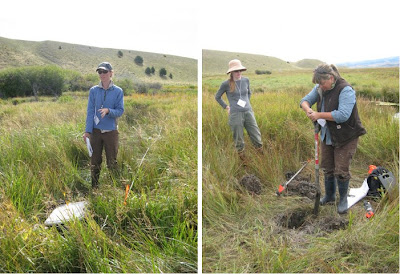 |
| Joanna explains laying out a vegetation plot (left), while Cat demonstrates digging a soil pit (right). Photo by J. Minter, EPA. |
The field trip took place at O’Dell Creek Ranch, an impressive wetland restoration site in Montana's Madison River Valley. More than 25 wetland professionals from around the region participated. The sun shined all day long and field trip participants were thrilled to be out on such a beautiful day with their feet wet and the sedges glowing yellow with the coming fall. All agreed it was a terrific day.
 |
| Cat explains rapid assessment protocols to field trip participants. Photo by J. Minter, EPA. |
All photos courtesy of Jill Minter, Wetlands Program, EPA Region 8.
Tuesday, February 2, 2010
Sixth Annual Rare Plant Symposium presentations now online
Presentations for the Rare Plant Symposium held in September 2009 are now available on the Botany Team page of our website. The meeting agenda and reviews of past meetings are also now available. Meeting minutes will be available shortly, so check back soon.
Thursday, September 17, 2009
Report from the 6th Annual Rare Plant Symposium

The 6th Annual Rare Plant Symposium, an off-shoot of the Colorado Rare Plant Technical Committee, took place on September 11, 2009. CNHP botanists Susan Panjabi and Jill Handwerk presented reviews of Colorado’s rare plant species, and solicited new information from participants. The meeting was attended by 50-60 people, including representatives of the Bureau of Land Management, City of Fort Collins, Colorado Natural Areas Program, Denver Botanic Gardens, The Nature Conservancy, US Fish and Wildlife Service, US Forest Service, University of Colorado Herbarium, and the Wyoming Natural Diversity Database, as well as other interested botanists from the region.
Some highlights included a report of new state records in New Mexico for two species: Porter’s feathergrass (Ptilagrostis porteri), and Colorado Divide whitlowgrass (Draba streptobrachia). Ben Legler was responsible for these finds, as well as discovering a new species of phlox from the Vermejo Park Ranch in northern New Mexico. These two species were previously believed to be endemic to Colorado. Although the new records extend the known range of the species, they are both still considered rare. Tim Hogan reported a county record and range extension for Saussurea weberi in Custer County.
 Draba streptobrachia (Colorado Divide whitlowgrass)
Photo by Peggy Lyon
The meeting included quite a bit of discussion about the federally listed species, which have been receiving more monitoring attention recently. Many participants also noted the large number of occurrence records from the northwestern portion of Colorado (especially Moffat County) which have not been observed for 20 years or more. Although we have good records of these species from the late 1980’s, CNHP has so far been unable to secure funding to re-survey these occurrences, or to look for new ones in this area. One of our primary challenges is how to fund the continual updates needed to keep our database current, since “stale” data makes conservation planning and action more difficult.
 Ptilagrostis porteri (Porter’s feathergrass)
Thursday, September 3, 2009
Collaborative Conservation Conference Sept. 8-11
Our friends at the Center for Collaborative Conservation are holding a conference titled Bridging the Gap: Collaborative Conservation from the Ground Up. The conference will be at Colorado State University from September 8-11 (next week!), and will focus on the power of pooling resources for effective conservation.
A number of CNHP folks will be there. If you're going, don't miss Susan Panjabi and Jessica Parker with their poster on the Rare Plant Conservation Initiative.
A number of CNHP folks will be there. If you're going, don't miss Susan Panjabi and Jessica Parker with their poster on the Rare Plant Conservation Initiative.
Subscribe to:
Posts (Atom)

