Showing posts with label About CNHP. Show all posts

Monday, October 16, 2017

2017 Colorado Rare Plant Symposium

Botanists and members of the Colorado Rare Plant Technical Committee (RPTC) were among the group of nearly 60 people gathered at Colorado College in Colorado Springs, CO, to attend the 14th Annual Colorado Rare Plant Symposium. The symposium is held each fall in conjunction with the Colorado Native Plant Society’s (CoNPS) annual meeting, and is hosted by the Colorado Natural Heritage Program (CNHP) and Denver Botanic Gardens (DBG).

Attendees included professional and amateur botanists with a common interest in Colorado rare plants and their conservation. This year Jill Handwerk (CNHP) presented data and photos of rare plant species known from southeast Colorado, along with the critically imperiled (G1) and federally listed plants species of Colorado. New this year was an afternoon review of the U.S. Forest Service (USFS) and Bureau of Land Management (BLM) sensitive species, led by Steve Olson and Carol Dawson, respectively. Additionally, Tim Hogan (CU Herbarium) provided herbarium specimens of the southeast Colorado rare species. The presenters encouraged participants to share their observations about the highlighted species and learn the latest information on Colorado’s rare plant conservation efforts.

Here are some highlights from the 2017 Symposium: 

New populations of rare plants reported in 2017 included populations of West Silver bladderpod (Physaria scrotiformis) and Gibbens’ beardtongue (Penstemon gibbensii).

Genetic studies continue to answer taxonomic and management questions for some of our state’s rarest species, including: boatshaped bugseed (Corispermum navicula), Mancos Shale packera (Packera mancosana), Kremmling beardtongue (Penstemon penlandii), North Park phacelia (Phacelia formosula), in addition to Sclerocactus species of western Colorado and eastern Utah.

Habitat was protected by the Colorado Natural Areas Program for Pagosa skyrocket (Ipomopsis polyantha) with the purchase of 88 acres of occupied habitat. Pagosa skyrocket is endemic to the Pagosa Springs area and is federally listed as threatened.

Steve Olson (USFS) provided an update on upcoming changes in how the USFS regional sensitive species lists are developed. The USFS is moving towards Species of Conservation Concern which must focus on ecological conditions, and will be based on NatureServe G and S ranks. Existing Sensitive Species will remain in effect until new management plans are developed for each forest.

Additional afternoon presentations were as follows: Raquel Wertsbaugh with the Colorado Natural Areas Program (CNAP) discussed the recent incorporation of rare plants into the State Wildlife Action Plan and the implications for land management and conservation. Jessica Smith (CNAP) discussed the implementation of monitoring for Pagosa Skyrocket at the newly acquired state owned property. Susan Panjabi (CNHP) gave a brief presentation regarding recently developed Best Management Practices for Roadside Rare Plants, and an overview of the online Colorado Rare Plant Guide. Moderator Jennifer Neale (DBG) concluded the symposium with a discussion of how we, as a group, can share our conservation successes with a wider audience.

For more information: 

All of the information from this meeting as well as previous symposia is available online at the Colorado State University, Colorado Natural Heritage Program (CNHP) website: www.cnhp.colostate.edu.

The Rare Plant Symposium is open to anyone with an interest in the rare plants of Colorado. For more information contact Jill Handwerk at jill.handwerk@colostate.edu or Jennifer Neale at nealejr@botanicgardens.org and check the CoNPS website (www.conps.org) for details as they become available about next year’s symposium.

Location of SE Colorado G2G3 plant species. 
Survey site for Pagosa Skyrocket. 
Pagosa Skyrocket.

Monday, January 27, 2014

CNHP Partners Meeting

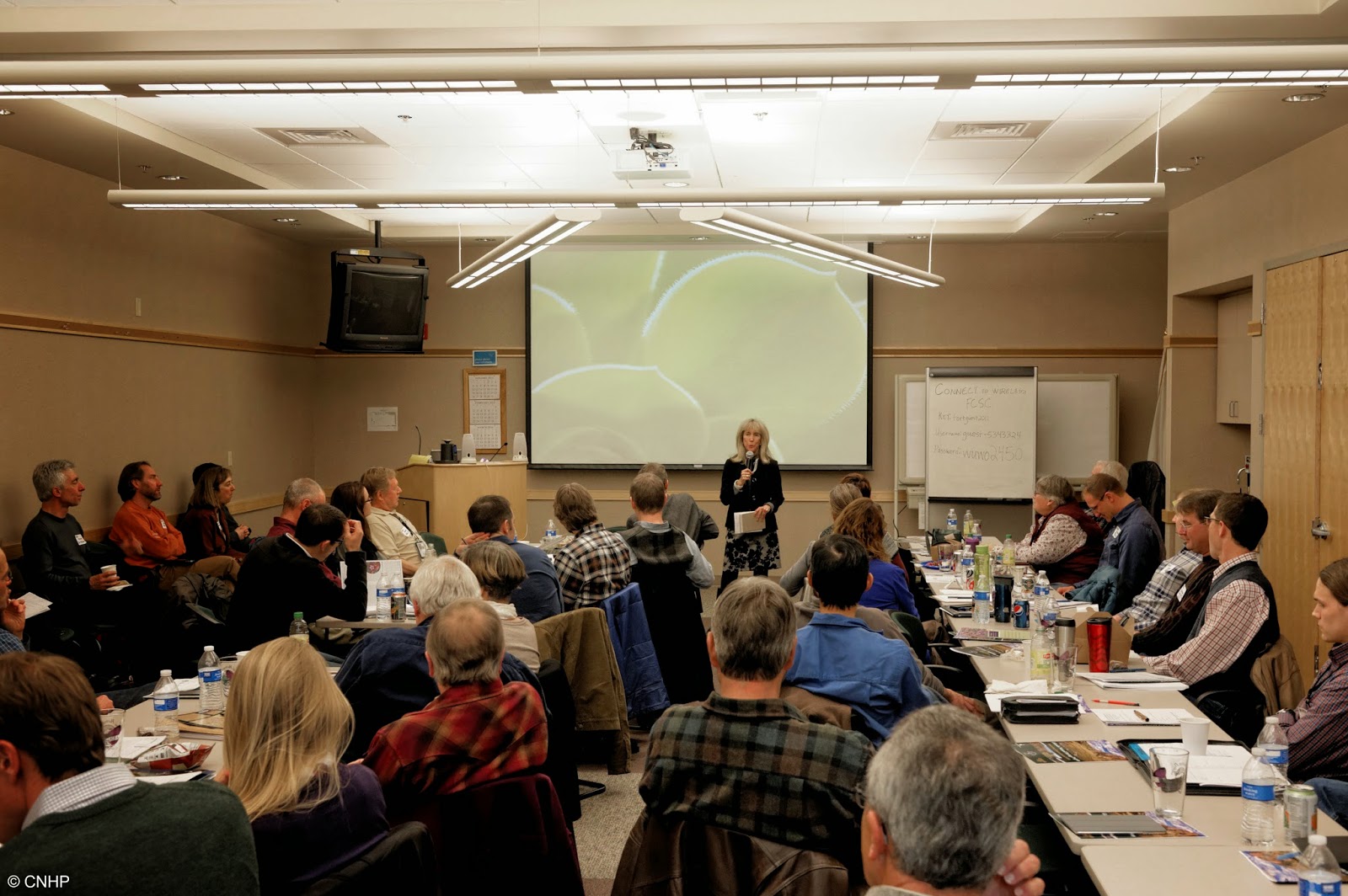
On January 14th, we held our first CNHP Partners Meeting.  We did this at the USGS Fort Collins Science Center, thanks to the generosity and hospitality provided by Jeff Morisette, Director of the North Central Climate Science Center, who made their conference room available to us.

Partners enjoying snacks and coffee together prior to the meeting

This was the biggest event we’ve ever hosted, and spending the day with 60 of our key partners was thrilling and wonderful for us.  We were sad that a few folks in the mountains could not make it due to the weather, but fortunately the snow did not impede travel for those of us on the Front Range.

Ken Wilson’s introduction to the partners

We started the day with a welcome from the USGS Fort Collins Science Center Director Dave Hamilton, and from Fish, Wildlife, and Conservation Biology Department Head Ken Wilson.

The distinguished participants getting the overview of the day from Dave

Then each of CNHP’s teams (Botany, Ecology, the Wetland Sub-team, Zoology, Conservation Data Services, and Conservation Planning) gave a short, 10-minute overview of their staff, key functions and projects, and directions for the future.  I followed them to roll up CNHP’s Future Directions just before lunch.

The partners engaging in a networking exercise- creating new
connections within Colorado’s conservation community!

After lunch, we turned the tables to our partners, ten of whom gave presentations about their current priorities, challenges, and ways that the folks in the room could connect and help to address them.  They were welcomed by Joyce Berry, who shared some very kind remarks about CNHP, and acknowledging our 20 years at CSU, gave CNHP $25,000!  This was a huge and wonderful surprise for us.

Del Benson, FWCB Faculty at CSU (left) and
Jeff Thompson, CPW (right), talking over lunch

Chris Pague and Tim Sullivan with the Nature Conservancy then started off, giving some historical perspectives of CNHP, and acknowledging three of our staff, Renee Rondeau, Lee Grunau, and Susan Panjabi, who have hit the 20 year mark in their distinguished careers.  They were followed by Karl Brown with NPS, Carol Dawson and Bruce Rittenhouse with BLM, Billy Bunch with EPA, Brian Mihlbachler with USFWS at the US Air Force Academy, Peter McDonald, Karen Lee, and Steve Popovich with USFS, Francie Pusateri with CPW, Mindy Gottsegen with SLB, and Kevin Johnston with the SRLCC.  Del Benson also gave an overview of the upcoming 8th International Congress for Wildlife and Livelihoods on Private and Communal Lands: Livestock, Tourism, and Spirit, to be held on Sept 7-12, 2014 in Estes Park.

Dean of the Warner College of Natural Resources Joyce Berry welcomes the Partners

I’ve gotten some nice feedback from several folks who came.  Tim Hogan, Collections Manager at the University of Colorado Museum of Natural History Herbarium, said “Just want to compliment you and all your comrades for putting on a very good show yesterday.  I do appreciate how much work is involved in pulling something like that together.  It was an interesting group of people, and it was a treat for me to see some folks I haven’t seen in too long a time and meet others whom I’ve never met face-to-face.”  Joyce Berry, Dean of the Warner College of Natural Resources, said “I really am so proud of all that you are doing.  Having all your partners show up like that is also another indicator of CNHP’s success.”

Chris Pague, TNC Senior Conservation Scientist,
sharing thoughts about working with CNHP

We have set up a new webpage where we’ve posted a recording with powerpoint presentations, notes, and photos from the event.  You can also see all of Michael Menefee’s photos from the Partners Meeting on our Facebook page.

Bruce Rittenhouse, BLM Natural Resources Branch Chief,
talks about BLM’s landscape-level approach to conservation through the REAs.

We are interested in continuing this, perhaps annually, and we are interested in feedback about the meeting and how we could do it better in the future.  We have posted a short survey where you can offer us comments and suggestions about this.

Thank you from all of us at CNHP to everyone who came and made this great day possible.  It was a huge thrill to spend the day with you and envision an exciting future together!

Thursday, January 10, 2013

New CNHP employee: Jeremy Sueltenfuss

After receiving a bachelor’s degree from Colorado College, my wife and I moved to Venezuela for two years, where we both taught at an international private school.  Teaching middle and high school science was a great way to pass on my passion for the natural world to young eager minds.  After teaching for two years, we moved back to Colorado for me to complete a Master’s degree from Colorado State University.

Jeremy Sueltenfuss and his dog Elvis
Though most of my undergraduate research focused on the response of various wildlife communities to forest management, my interest in wetlands brought me to CSU to look at the impacts of irrigation in the west on wetland ecosystems.  Agricultural diversions have severely degraded the majority of western rivers, but leaky earthen canals transporting this water over large distances create a substantial amount of wetland area across our otherwise arid landscape.  After graduating in the summer of 2012 I worked on a wetland restoration project for the National Park Service.   Historic land use at Florissant Fossil Beds had channelized a wet meadow in the area.  We filled each of the channels and restored the natural hydrologic regime within the valley.  After this great experience CNHP hired me as a wetland ecologist and GIS specialist and I couldn't be happier!

Tuesday, December 25, 2012

CNHP’s 2012 Annual Recognition Event

By CNHP Director, Dave Anderson

I regret to report that unlike two blogs in the past month, this one does not involve beer, but it does involve margaritas!  We held our annual recognition event at The Rio Grande Mexican Restaurant last Friday.  With some of our partners and colleagues, we honored CNHP’s volunteers, students, and staff over a delicious buffet lunch in the Agave Room at the downtown Fort Collins restaurant. 

Revelers in the Agave Room - what a nice venue!
 We could not do what we do without our volunteers and students, and they bring enthusiasm and fresh ideas to CNHP every day!  Our three 2012 CNHP Outstanding Volunteer Awards went to Stacey Anderson, Julie White, and Rebecca Hopson this year.  We are so grateful to them for their commitment to CNHP and wonderful work.  We also gave recognition to the long list of other volunteers who have worked with us in 2012!  Tanya Stevens, our newest volunteer, joined us as well.

Katie Schneburg and Michelle Kamandy - two of CNHP’s amazing work study students

Julie White, winner of a CNHP Outstanding Volunteer Award,
and her fiancé

Rebecca Hopson, winner of a CNHP Outstanding Volunteer Award,
with Jill Handwerk, Botany Team Leader
We gave certificates to our current student staff members- Michelle Kamandy, Nathan Jensen, Jacqui Marquez, Gabe Scott, Katie Schneberg, and Sally Ebeling. 

And our three grand prize winners of the CNHP Photo Contest were Michael Menefee (landscape), Jeremy Siemers (species), and Pam Smith (people at work).

Michael Menefee's winning landscape photo of the High Park fire
 We recognized Michelle Fink, Karin Decker, and Gabrielle Smith for coordinating the wildly successful CNHP Blog.

And last but not least, our kitchen cleaning team, led by Pam Smith, received the prestigious Green Sponge Award, for improving our standard of living tremendously here at the CNHP office. 

Winners of the prestigious Green Sponge Award, led by Pam Smith
(with the big green sponge and “scepter”)
Our distinguished guests included Chris Pague and Rick Knight, both of whom were instrumental in bringing CNHP to CSU!  Heather Knight, one of CNHP’s first employees and current partner at TNC, came as well.  Ken Wilson, Department Head of FWCB, came along with Val Romero and Mary Olivas-Lee from our Budget Office.  Brad Johnson and Jen Ackerfield, our colleagues at CSU came also.  Brian Sullivan and Eric Odell, two of our wonderful partners at Colorado Parks and Wildlife joined us along with our friends at CEMML, Lee Barber and Dave Jones.  We even got to catch up with a couple former employees, Jodie Bell and Jared Papert-Stockton. 

Rick Knight, CSU Professor,
 Chris Pague, TNC Senior Scientist and former CNHP Director, and
Heather Knight, TNC Laramie Foothills Project Director.
It was a wonderful afternoon, and thank you to all who could come and be a part of it. 

Tuesday, June 12, 2012

High Park Fire

(click for larger image)

CNHP staff are getting a close-up view of the High Park fire, which is burning on mostly private land west of town.

The High Park burn area, like much of the Front Range foothills, is covered by extensive tracts of the ponderosa pine ecological system. Although we know that fire is a natural and expected ecological process in this ecosystem, the effects of wildland fires this close to the urban interface can be severe, with serious threats to life and property. Thank you firefighters for your tremendous efforts to control this blaze! Good luck and here's hoping for better weather to come.

Wednesday, April 18, 2012

CNHP Website User Survey

Calling all CNHP blog followers and website users! We’re working on a service-learning project with a group of Environmental Communication students at CSU this semester, who, among other things, have put together a short online survey to help us better understand what sections of our website are most useful and where we can improve. It only takes 5 minutes, and the results will enable us to communicate more effectively with those of you who use our website and blog.

Please take the survey no later than April 30, 2012. After that, we will compile your responses. All responses are anonymous.

Thanks for your help, your feedback is important to us!

The CNHP Team and Environmental Communication students

Click on the link below and please, fill out the survey!
https://www.surveymonkey.com/s/XGCQBLW

Wednesday, October 19, 2011

CNHP takes over maintenance of COMaP

The Colorado Ownership, Management, and Protection (COMaP) project was initiated by Dr. David Theobald, Associate Professor in the College of Natural Resources at Colorado State University (CSU). The goal of COMaP was to build a statewide protected areas map for Colorado from all of the disparate sources of land ownership and management data throughout the state. The first version of COMaP was released on May 28, 2004 as COMaP v1.

Annual updates and improvements to COMaP through version 8 have been funded by the Colorado Division of Wildlife and Great Outdoors Colorado (GOCO). In 2010, funding was provided via a USGS GAP Stewardship proposal to allow COMaP to become integrated with their national Protected Areas Database (PAD-US). At that time, responsibility for maintaining, updating, and distributing COMaP became a collaborative effort between CNHP and the CSU Geospatial Centroid.

Maintaining COMaP is a natural fit within CNHP's mission and, indeed, many other Natural Heritage Programs and Conservation Data Centers across the nation (all part of the Natural Heritage Network) are the state stewards for protected areas data.


With the funding from the PAD-US project, CNHP was able to update COMaP again, and version 9 is now available for download from CSU's Geospatial Centroid. This round of updates focused on state, regional, and local government lands in addition to GOCO funded conservation easements.

We would like to thank all of the agencies and organizations that submitted updates and corrections, your contributions have been essential to the success of this project!

Thursday, August 18, 2011

Data on website updated for 2011

The data that we have available for download and viewing on our website has been updated for 2011. This includes updated potential conservation area reports; downloadable GIS data for element lists by 7.5 minute quad, potential conservation areas, and network conservation areas; updated tracking lists; and an updated interactive map of where CNHP is working this year.

These datasets get updated annually and they are available for free for non-commercial purposes only. For more up-to-date, detailed, specific, and/or commercial use information please contact our Environmental Review Coordinator, Michael Menefee.

Thursday, June 16, 2011

New online data submission forms

The Colorado Natural Heritage Program tracks and ranks Colorado's rare and imperiled species and habitats, and provides information and expertise on these topics to promote the conservation of Colorado's valuable biological resources.   Data maintained in our central tracking database (BIOTICS) are an integral part of the Natural Heritage Network and play a role in ongoing research at CSU. These data reflect the observations of many scientists and institutions and provide a record of the current state of knowledge of Colorado's biodiversity.

These data are acquired from various sources, including you! If you have field survey data that you would like to submit for inclusion in BIOTICS, we now have online data submission forms to supplement the hard-copy field forms, both of which can be accessed here.  We hope these web forms make it easier for you to submit your data to us and, as always, we welcome any feedback about how the forms work for you.

Tuesday, May 3, 2011

Check out our improved Reports page


Big thanks go out to CNHP Web Intern Ryan Nelson, IT Tech Garrett Pichler, and members of our Ecology Team for improving the functionality of our Documents and Reports Page. You can now filter all of our online reports by title, author, or year. Just click on the Filter Reports button on the web page to get the filter form:


We hope to soon add additional filters, such as by county and discipline, so stayed tuned for further improvements, and let us know what you think.

Thursday, March 24, 2011

Welcome new wetland team members!

As we gear up for the 2011 field season, new employees are appearing at CNHP. The wetland ecology team already has a few new faces:

Gabrielle Smith is our newest wetland mapper. Gabrielle is originally from Florida, where she earned a BS in Wildlife Ecology and a MA in Urban Planning (GIS concentration), both from the University of Florida. Before coming to Fort Collins, she worked at the conservation organization Ducks Unlimited in Ann Arbor, Michigan – doing wetland mapping, similar to the wetland mapping work she is now doing here at CNHP.

Joelle Laing also joined the team this month to participate in the National Wetland Condition Assessment, a research initiative from the EPA to assess the condition of wetlands across the lower 48 states. She recently graduated with an M.S. in Restoration Ecology from North Carolina State University, where she researched Atlantic White Cedar restoration in the (perilous) Great Dismal Swamp after hurricane damage. Over the last eight years, she has had a grab bag of experiences across the US in restoration, fire ecology, plant identification, and soil science at Rocky Mountain Research Station, The Nature Conservancy, and a consulting firm. She’s excited to explore Colorado and Wyoming this season and do some intensive wetland botanizing.

 Joelle honing her plant ID skills.

Tuesday, February 22, 2011

Online Data Request Form

The CNHP Biological and Conservation Data system is used to evaluate projects for potential impacts to rare resources. By working early in the planning phase of a land management or development project we strive to avoid and minimize impacts while considering alternatives that allow projects to be implemented.

Information from CNHP's state-wide data system is available to the public, and can be used for conservation planning and to help facilitate the design and implementation of ecologically sound development projects. CNHP has worked with landowners, local planning departments, government agencies, consulting firms, and conservation organizations. New pipeline, roads, mines, and general conservation planning are excellent examples of projects where CNHP information has been of use. Learn more about the kind of data we have and our data request fee structure.

All data requests go through CNHP Environmental Review Coordinator, Michael Menefee. In addition to calling or emailing Michael directly (see our contacts page), we have recently implemented an online data request form. We hope this additional option gives you the flexibility to contact us in a way that best suits you. If you have any feedback regarding the online form, don't hesitate to let us know.

Thursday, February 10, 2011

Online Rare Plant Guide updated

Online Rare Plant Guide Screenshot

Our online Rare Plant Guide is a heavily used resource by area botanists, plant ecologists, and land managers. It was originally created as a set of static html web pages some dozen years ago as a companion to the 1997 hard-copy guide, and has sorely needed an upgrade for a while now. We have now completed the first steps of this upgrade! Please take a moment to look over our new and improved Online Rare Plant Guide.

A big thanks go out to Ryan Nelson, CNHP web intern, Garrett Pichler, CNHP Systems Administrator, and Michelle Kamandy, CNHP botany work-study, for making this upgrade possible. But wait, there's more! (or will be eventually) The current upgrade focused on bringing the look and feel of the guide in line with the rest of our website and improving navigation. Some content was updated (mostly the G and S-ranks and federal status for each species), but further updates, additions, and improvements are planned for the future, with a projected completion date of spring 2012. So stayed tuned, and please update your bookmarks if you link to our Rare Plant Guide. Thank you!

Tuesday, February 1, 2011

Back from Capitol Hill

DC in January. At least there wasn't any snow at the time.

In what is becoming an annual pilgrimage, CNHP Director Dave Anderson was on Capitol Hill last week while visiting the NatureServe national offices in Arlington VA. He was able to share with our Senators and with Congresswoman DeGette some of the exciting things CNHP is doing, and ask them to pay attention to continued funding for the kind of work that we do.

Dave and NatureServe director Mary Klein at Diana DeGette's office

During his visit, he participated in kicking off NatureServe's Strategic Plan for 2012-2017 – and brings some valuable lessons home to CNHP's upcoming strategic planning workshop.

The NatureServe and Natural Heritage Network partners hard at work planning for the future.

The NatureServe planning workshop developed a set of eight goals, each with several milestones, for NatureServe to work on from June 2011 to June 2012. The Biotics roll-out and development was the key theme that all participants worked on together, and then divided into teams to define seven other goals. Everyone has learned a lot about how to make this process more effective over the last three years of planning meetings, so a lot of progress was made this year.

Even so, Dave was happy to get out of the latest east coast snowstorm and back to Colorado! (Just in time for our own record-breaking cold snap - brrr!)

Wednesday, January 19, 2011

Supporting Students

CNHP is affiliated with the Warner College of Natural Resources at Colorado State University and, as such, we routinely engage CSU students and collaborate with faculty in our work. Not only do we employ many current and former CSU students in both permanent and temporary positions, we also engage students through lectures, internships, work-study opportunities, field trips, and assistance with thesis and research projects. CNHP is proud of the growing role we play in the excellent education CSU students receive. Students that have worked with us in various capacities have gone on to become leaders in the conservation and natural resources fields.

Here are some statistics for 2010:
Lectures given by CNHP employees as guests in WCNR classes:18
CNHP staff with instructor roles:3
Students employed at CNHP:12
Credits earned by CSU students for internships at CNHP:4
Work-study hours completed at CNHP:458


CNHP Outreach Intern Kevin Adams got to meet U.S. Senator Mark Udall while at the 2010 Colorado Stewardship Forum this past November.

Wednesday, December 22, 2010

Happy Holidays from CNHP

From our family to yours, we hope you have a peaceful and happy holiday season.

pretty snow covered mountain scene
Red Mountain, photo by Peggy Lyon

The blog will be back in business in January, see you then!

Thursday, November 25, 2010

Happy Thanksgiving from CNHP

To all our USA readers - have a safe and happy Thanksgiving holiday. To everyone else, have a great Thursday! :)

Wild turkey with word balloon: What's a turkey go to do to get a G1 Ranking around here?
A little Natural Heritage Network humor there.

(Those of us here at CNHP who are vegetarian are rooting for the turkey. But pumpkins had better watch out.)

Thursday, August 5, 2010

Data on website updated for 2010

The data that we have available for download and viewing on our website has been updated for 2010. This includes updated potential conservation area reports; downloadable GIS data for element lists by 7.5 minute quad, potential conservation areas, and network conservation areas; updated tracking lists; and an updated interactive map of where CNHP is working this year.

These datasets get updated annually and they are available for free for non-commercial purposes only. For more up-to-date, detailed, specific, and/or commercial use information please contact our Environmental Review Coordinator, Michael Menefee.

Thursday, July 1, 2010

Bob Jenkins Visits CNHP

By Dave Anderson, CNHP Director and Chief Scientist

We recently had a very special guest visit CNHP! We were visited by Bob Jenkins, who is famous within the world of conservation for inventing much of the methodology used by natural heritage programs, and for starting the network of natural heritage programs, of which CNHP is a part. When he was the Chief Scientist of The Nature Conservancy, Bob pretty much single-handedly created the network of natural heritage programs and got many of them started as components of state governments (a number of the programs, like CNHP, are instead affiliated with universities). His innovation and determination has led to the creation of an international enterprise that employs thousands of scientists working in 82 programs throughout the Western Hemisphere, and unified by the methods he developed as member programs of NatureServe.

Bob Jenkins (red plaid) talks to CNHP folks in our conference room.

Bob coined the term "element" to collectively recognize species and natural communities as fundamental units of conservation. He was the first person to see a way to prioritize elements based on their rarity, distribution, and qualities of their populations, and use that prioritization as a framework to guide conservation efforts. His work transformed the way that The Nature Conservancy makes decisions about land acquisitions and management.

Bob shared several stories with us about the formation of the Natural Heritage Network. It was great to hear the personal side of his moments of discovery (his "Eureka" moments). Bob had several of these during his career that led to transformative and monumental changes in the way we view conservation. Bob also talked with us about our challenges and successes and how our program is doing. It was such a treat to have one of the conservation community's greatest thinkers in our midst to ponder these with us. And somehow, having a visit from our founding father was incredibly validating and inspiring. Thank you so much Bob! I hope we will see you again soon.

Bob at the whiteboard

At the Biodiversity Without Boundaries Conference in Austin Texas in April, NatureServe awarded Bob the first NatureServe Conservation Award for his achievements. He said that of all the awards he's received, this one meant the most to him. Read more about Bob's award and the text of his acceptance speech, in which he tells the story of the formation of the network of heritage programs.

Tuesday, June 8, 2010

Volunteering for conservation

It's a small world in Colorado conservation. Over the years many of our staff (and former staff) have served in volunteer positions with a number of other Colorado non-profits and coalitions, including the Colorado Native Plant Society, the Colorado Natural Areas Program, the Colorado Rare Plant Technical Committee, the Colorado chapter of the Wildlife Society, local Audubon chapters, the Colorado Fourteeners Initiative, the Shortgrass Prairie Partnership, the Colorado Renewables and Conservation Collaborative, the Colorado Noxious Weed Advisory Committee, and more.

When they aren't working or playing in Colorado's beautiful environment, CNHP staff keep busy by lending their expertise to other organizations, leading field trips, giving presentations and workshops, and working to build and strengthen our state's conservation community.

CNHP Ecologist Renée Rondeau recently led a Colorado Native Plant Society field trip to Pueblo Chemical Depot to identify prairie plants and view a riparian restoration project.

Renée (red shirt) discusses plant identification with members of the Colorado Native Plant Society.
Photo by K.M. Canestorp, U.S. Fish and Wildlife Service.