Showing posts with label Conferences. Show all posts

Monday, December 4, 2017

Talking Myrmecophily: Tristan Kubik Presents His Findings at the High Country Lepidopterists Society

The High Country Lepidopterists Society hosted their 28th annual meeting at Colorado State University this December, and CNHP had a representative presenting his research and pal-ing around with the who’s-who of Colorado’s butterfly biologists. Undergraduate Tristan Kubik, who has his research project “Facultative myrmecophily in the hops blue butterfly (Celastrina humulus)” in review in the journal Entomological News, presented his findings to an audience of approximately 30 entomologists. Tristan conducted this research prior to his sophomore year, and has since developed research to study firefly populations along the Front Range of Colorado. He has proposed population sampling for the rare honey ants of Garden of the Gods Park in Colorado Springs. Congratulations, Tristan!
Dr. Paul Opler displays the conference program and introduces Tristan.

Tristan acquaints an audience of lepidopterists to myrmecophily.

Tristan talks about the variety of ants seen tending hops blue butterfly larvae.

Monday, December 12, 2016

46th Annual Symposium of the North American Society for Bat Research

In October, Rob Schorr attended the 46th Annual Symposium of the North American Society for Bat Research in San Antonio, Texas. During his time there, Rob presented a poster discussing the progress and data analysis from a project to monitor maternity colonies of little brown bats (Myotis lucifugus). He and Jeremy Siemers have been conducting a mark-recapture study of little brown bats at two roosts in the Yampa Valley. The intent of this project is to develop baseline estimates of survival, understand roost fidelity, and describe roost conditions for the little brown bat.
Rob manning his poster at the 46th NASBR meeting.
The Mission San Antonio de Valero (The Alamo) was right across from the meeting venue.

Thursday, August 20, 2015

CNHP Map Will Support Governor's Colorado Beautiful Initiative

Colorado Natural Heritage Program director David Anderson, along with staff members Amy Greenwell and Michael Menefee, were thrilled to participate in The Outdoors Summit in downtown Denver this summer. The Summit convened to help launch new initiatives to protect, preserve and enhance the state’s great outdoors and natural areas. Conservation leaders from around the state attended the event. Speakers included Governor John Hickenlooper and former Interior Secretary Ken Salazar among many other notable participants.

Governor John Hickenlooper presents his Colorado Beautiful plan at the Outdoors Summit in Denver, Colorado.
During the Summit, Governor Hickenlooper rolled out his Colorado Beautiful plan, an exciting conservation initiative that ultimately aims to enable every Coloradan to live within a 10-minute walk of an open space natural area. Great Outdoors Colorado (GOCO) has awarded $15.6 million in grants to support the Colorado Beautiful plan. A hallmark of the plan will be the creation of an interactive trail and recreational lands map. The map will use CNHP's existing map of Colorado's protected areas, called The Colorado Ownership, Management, and Protection (COMaP). COMaP is a dataset maintained by CNHP and the CSU Geospatial Centroid.

The complete Colorado Beautiful map is scheduled for completion in 2016. The map will also help guide plans to preserve and strategically protect Colorado’s most threatened landscapes, waterways and urban open spaces. It will also be used to identify 16 high-priority trail projects to help connect people to more recreational opportunities. The map will include all the state's trails, open spaces, parks and protected lands in a single site. “Colorado Beautiful, we believe, is not only about connecting our parks, trails and scenic lands, but about connecting people to the outdoor delights that set Colorado apart as a special place,” Hickenlooper said. “It’s important to bring our newest generations outside, away from electronic distractions and into the splendor of our waterways, forests, wildlife, grasslands, mountains and canyons.”

An image of the Colorado Ownership, Management, and Protection map (COMaP) that will be integrated into the Colorado Beautiful map proposed by Governor Hickenlooper.

Tuesday, May 20, 2014

CNHP wins the 2014 Collaboration Award at the Biodiversity Without Boundaries Conference

This year’s Biodiversity Without Boundaries Conference was held in New Orleans April 6-10, and eight of our staff were able to attend this time, giving a wide range of presentations on our work while building connections with other members of the NatureServe Network. There were many highlights from this conference - it is always a place where we form new friendships and renew old ones, and become energized by learning about all the amazing things happening throughout the Network. Three of our staff also completed training in Leadership (Jeremy Sueltenfuss and Rob Schorr) and Natural Heritage Methodology (Bernadette Kuhn).

One of the most exciting highlights this year was receiving the Collaboration Award. This award is given to one program each year, who is selected based on nominations from other programs around the Network of 82 programs in Canada, the US, and Latin America, as well as NatureServe. CNHP was nominated for our collaborations with other programs and innovative partnerships for conservation. These contributions include our role with the US Section Council, our participation in the NatureServe Leadership Program, our lead role in crafting the NatureServe Network statement of shared goals and values, and our partnership with Odell Brewing Company to conserve the Hops Blue butterfly. Sabra Tonn, Program Supervisor for the Arizona Heritage Data Management System, was able to get ahold of a few of the last bottles of Celastrina, which Mary Klein, President and CEO of NatureServe, gave to each of the winners of the awards this year! So we enjoyed getting to taste this beer with others around the Network during the award ceremony.

Mary Klein, President and CEO of NatureServe, announcing the award winners at
Biodiversity Without Boundaries, sweetening the pot with
bottles of Celastrina for the award recipients. 

The other winners of awards this year were the New York Natural Heritage Program (Conservation Impact), and Michigan Natural Features Inventory (Scientific and Technological Achievement).

David Anderson, Director of CNHP (Collaboration Award),
DJ Evans, Director of the New York NHP (Conservation Impact Award),
and Brian Klatt, Director of the Michigan Natural Features Inventory
(Scientific and Technological Achievement Award).
We did not all plan to wear blue shirts!

It is such a huge honor to be recognized by our peers for our collaborations and partnerships. Because this award is based on cooperation, we really feel that it is as much a testament to our own collaborations as it is to those of the other members of the NatureServe Network, who have embraced so many challenges and opportunities with us in recent years. Being part of a network that is so deeply committed to the grand collective effort we make to conserve biodiversity is something that gives all of us a reason to go home from work feeling good about what we did each day! And we feel very fortunate to be able to draw so much inspiration from the NatureServe Network, and the partners that we work to assist every day.

Left to right: Bernadette Kuhn, Renee Rondeau, Jeremy Sueltenfuss, Susan Panjabi,
Rob Schorr, Jill Handwerk, Michael Menefee, David Anderson, Anibal Ramirez Soto
(Pronatura Veracruz, Mexico), and Mary Klein (President and CEO, NatureServe).

Check out the NatureServe press release about our award here!

Monday, January 28, 2013

A Trip to Washington DC

by David G. Anderson

A visit to Washington DC is always interesting and inspiring, and my trip this month was no exception!  There were several reasons to go this time.  I gave two presentations on CNHP’s projects at the Transportation Research Board’s (TRB) annual Meeting.  One was on our wildlife escape ramp study, led by Jeremy Siemers, and funded by CDOT.  The other was on our pilot test of the Integrated Ecological Framework, a project funded by TRB.  

  
Participants in TRB’s annual meeting at the Washington Hilton.
This conference coincided with the Disasters and Environment Conference, held by the National Council for Science and the Environment.  CSU is a sponsoring institution of this conference and our Dean, Joyce Berry, and our Provost Rick Miranda were there.   There were presentations by many inspiring environmental leaders (the outgoing director of NOAA, Jane Lubchenco, gave a memorable presentation). 

The beautiful Ronald Reagan Building, where the
Disasters and Environment conference was held.  
And of course, I also spent a day visiting our friends at NatureServe’s headquarters in Arlington, Virginia.  With Leslie Honey, Vice President of Conservation Services for NatureServe, I met with Dan Fenn, a staffer in Senator Mark Udall’s Office.  We showed him the State of Colorado’s Biodiversity 2011 and gave him a copy of CNHP’s High Park Fire poster, and it was a wonderful opportunity to highlight some of the ways that we can help identify no-regrets conservation solutions.  Leslie and I made a great team and I hope we can visit our congressional representatives again before long!  It was fun to visit our friends at NatureServe- thank you to everyone (Pat, Leslie, Lori, Don, Rob, Kat, and Bruce) for your hospitality. 

Two of our friends from Oregon, Jimmy Kagan (Director of the Oregon Biodiversity Information Center (ORBIC), CNHP’s analog in that state) and Lisa Gaines (Director of the Oregon Institute for Natural Resources), spent the week there as well and we did a pretty good job of trying some of Washington’s fabulous culinary offerings together while figuring out how to conserve the world's biodiversity.  Jimmy and I visited the wonderful United States Botanic Garden between meetings on the last day of my stay.  One of my favorite things there, aside from the beautiful orchid collection, was getting to see the Wollemi pine.  I had read about the discovery of this ancient tree species in the Blue Mountains of Australia 10 years ago, and it was wonderful to meet this species in person!  

Jimmy Kagan, Director of the ORBIC - a rare species indeed.

Wollemi Pines in the Rare and Endangered Species
Collection at the US Botanic Garden
On the last evening of my stay I walked down Pennsylvania Avenue back to my hotel (after stopping for a beer near the Whitehouse, where I met the City Manager of the City of Auburn, WA and a former hedge fund manager for Louis Bacon - both classic Washington DC experiences), and followed the parade route for Obama’s Inauguration.  

Pennsylvania Avenue on January 17th, just before Obama’s Inauguration
It was wonderful to showcase CNHP’s success, leadership, and conservation innovations in Washington DC with our national leaders.  I am so proud to work at a Heritage Program that has so much to offer in this regard! 


Tuesday, May 15, 2012

Species Modeling at BWB2012

By Gabrielle Smith, CNHP Wetland Mapping and GIS Specialist

This year’s NatureServe Biodiversity without Boundaries (BWB) conference took place in Portland, OR and we lucked out with a week of unusually sunny weather. The conference was a great opportunity to meet staff from other Natural Heritage programs and learn about their work. I attended sessions focused on mapping and modeling and learned a great deal. One of the early talks was on the subject of increasing modeling capacity at the various programs, and on that note, I went out to receive some training.

The highlight of the trip for me was an R training workshop held at the Oregon Biodiversity Information Center on the Portland State University Campus. The training was led by Emile Henderson of the Oregon Biodiversity Information Center and Tim Howard from the New York Natural Heritage Program. The workshop was focused on building species distribution models using the RandomForest ensemble classifier object in the statistical software package R.

R Project Logo, courtesy of http://www.r-project.org/
The R Project - Not just a letter of the alphabet anymore.

The basic concept of species distribution modeling is that you know locations where a species has been observed and you also know things about the environment at the locations where the species have been observed. If you have many species observations, and many range-wide GIS data layers that represent variables such as elevation, aspect, annual precipitation, soils, geology and many other variables, you can combine these pieces of information to create a profile of environmental variables that supports the species. Then you can look at other places, places the species has not been observed and say “do the environmental variables at this location match up to what I know about where this species likes to live?”

Ipomopsis globularis species distribution map
A CNHP created species distribution model for Ipomopsis globularis (globe gilia), a rare plant found only in the mountains of Colorado (click for larger version). The dots show the known occurrences of the species, the green shows the results of the model, suggesting other places to look for the species.


The output of the modeling process is a raster (cell-based) dataset that for each cell includes a probability of the species occurring in that cell location. The modeler can set a probability threshold so they can effectively say “show me every raster cell that has a 75% or greater chance of my species of interest occurring in that cell.” The resulting species distribution model can guide future field surveys of the species of interest or guide conservation planning action. Models are no substitute for on-the-ground field work and observations, but they can be a useful tool to guide fieldwork and discover the qualities that make habitat suitable for a species.

A long term goal of modeling all tracked species by all member programs emerged from this year’s BWB conference. A challenging goal to be sure, but one that I hope to help CNHP achieve!

Wednesday, May 9, 2012

Field Trip to Columbia Gorge with WNHP

by Kirstin Holfelder, Database Developer and Assistant Database Administrator

As an ecologist turned data manager, I was particularly looking forward to getting out during the field trips that kicked off the 2012 Biodiversity without Boundaries meeting. There’s nothing more fun than hiking with botanists, ornithologists, and entomologists; people who are passionate about their science. You may only cover a half a mile of ground every two hours, but you will know that half mile very well.

Washington NHP director John Gammon and Robin Dobson, an ecologist who helped establish the Columbia River Gorge National Scenic Area, co-lead a trip that started in the lush forests of the Cascade Range’s western slope and travelled up the Columbia Gorge to the drier eastern side. We couldn’t have had more knowledgeable guides to the cultural and natural history of the area.

Temperate rain forest on the western side of the Cascade range (photo by Kirstin Holfelder)
The Columbia Gorge is a canyon that marks the state line between Washington and Oregon. It was formed largely during the last ice age by the Missoula Floods. It seems there was a glacial lake up there in Montana that periodically broke through its ice dam to release the epic quantities of water required to carve a gorge 80 miles long and 4000 feet deep. The unique geological history is echoed by the biodiversity of the area. Temperate rainforests transition to dry woodlands, then to grasslands as you travel east along a decreasing rainfall gradient. We ended our day in ponderosa pine meadows that bear a striking resemblance to Colorado’s Front Range.

Ponderosa pine meadow, looking east towards the dry grasslands of the Columbia Plateau (photo by Kirstin Holfelder)
Late April is a wonderful time to visit, because many of the wildflowers are blooming. I admit I may have contributed to the slow pace of the hike by stopping to take half a dozen pictures of each. My favorite by far was death camas (Zigadenus venenosus). It is a poisonous plant that looks unfortunately similar to members of the edible Camassia genus when not in flower. The Camassias were a staple food source for Native Americans in the area, so it’s not hard to see how death camas got its name.

Death camas in a field of wild flowers (photo by Kirstin Holfelder)
Throughout the field trip, Robin and John talked about the collaboration between scientists, land owners, and interest groups that made the creation and management of the scenic area possible. As I strolled through wildflowers and observed endangered western pond turtles, I got to personally experience how amazing the results of such cooperation can be. When interested people committed to working together make informed decisions, it’s truly amazing what we can accomplish.

Tuesday, May 8, 2012

Congratulations to the Washington Natural Heritage Program

by David G. Anderson

Eight CNHP staff attended the Biodiversity Without Boundaries (BWB) conference this year in Portland, Oregon. BWB is hosted by NatureServe in April every year and is a gathering of the members of the Network of Natural Heritage Programs and their broad group of partners. The conference was excellent this year and included numerous highlights that we will share in a few subsequent blogs.

One exciting event for Colorado was to help celebrate the Washington Natural Heritage Program’s receipt of the NatureServe’s Member Program Conservation Achievement Award this year! This is very exciting to us because of our numerous ties with Washington NHP. Our closest tie is a former employee, Joe Rocchio, who moved to the Washington NHP in 2007. While working at CNHP Joe, with scientists at NatureServe and the Environmental Protection Agency, began developing methods for Ecological Integrity Assessment (EIA) for wetland plant communities. He has spearheaded efforts to use these methods to create a much more rigorous and transparent approach to assigning element occurrence ranks to individual occurrences of plant communities.

John Gamon, the director of the Washington Natural Heritage Program (at podium) accepts the Member Program Conservation Achievement Award. Joe Rocchio, WNHP Ecologist (in plaid shirt) listens along with Mary Klein, CEO of NatureServe (seated), and another WNHP staff member (background). Photo by Dave Anderson.

Joe has continued to develop these methods at Washington NHP. Washington has now developed EIAs for 67 plant communities in Washington including numerous upland types. Congratulations to Washington NHP for their success and leadership!

Wednesday, September 28, 2011

8th Annual Colorado Rare Plant Symposium this Friday

Update: The post originally said the RPTC meeting was Saturday. It is, in fact on Friday, the day before the CoNPS annual meeting. We apologize for the error.

The Colorado Native Plant Society's annual meeting is this weekend (September 31 - October 1) in Carbondale, Colorado. In conjunction with that meeting, the Colorado Rare Plant Technical Committee (RPTC) will hold its 8th Annual Colorado Rare Plant Symposium on Friday (Sept. 30th) from 9:00 a.m. - 4:00 p.m. at the Third Street Center on 520 S. Third St., Carbondale.

The RPTC is an ad-hoc group of agency, academic, and NGO botanists that has been working for years to advance rare plant conservation efforts in the state. This year, the RPTC will provide a photo review of the federally listed threatened and endangered plant species known from Colorado, including some recently listed species. Discussion of their relationship to Colorado’s important plant biodiversity areas, current conservation status, critical habitat designation and potential threats will be emphasized.

The symposium is open to any one with an interest in the rare plants of Colorado. Come prepared to exchange your knowledge of our rarest species with other amateur and professional botanists from throughout the state.

Contact Jill Handwerk for more information (970-491-5857). Registration is $10. To register visit the CoNPS website or register at the door.

Thursday, March 3, 2011

Colorado Chapter of The Wildlife Society Annual Meeting

As part of his duties as Secretary for the Colorado Chapter of The Wildlife Society (CCTWS), CNHP Zoologist Rob Schorr spent the last full week of February at the CCTWS Annual Meeting. The theme of this year's meeting was "From the Cradle to the Grave: Recruiting and Retaining Natural Resource Recreationists."

The meeting was hosted with the Colorado/Wyoming American Fisheries Society and was attended by over 325 wildlife and fisheries biology professionals. The plenary session included speakers from the Colorado Division of Wildlife, Wyoming Game and Fish, The Humane Society, and the U.S. Fish and Wildlife Service, but the most-anticipated speaker, Ted Nugent of rock-and-roll and television fame, presented a unique perspective on the value and importance of retaining hunters and anglers.

Tuesday, March 1, 2011

CSU student involvement in CNHP


One of our work-study students, Katie Dykgreve, recently presented a poster at the 17th annual Front Range Student Ecology Symposium about our newly improved Online Rare Plant Field Guide.  Katie and our website development intern Ryan Nelson, worked with CNHP Systems Administrator Garrett Pichler, Botany Team Leader Jill Handwerk, and Director Dave Anderson on the overhaul of the guide.  Her poster included a mock-up of what the concept for a page in the new online guide will look like when implemented.

 Katie discusses her poster.

Katie reported:
“Observers and presenters crowded the North Ballroom of the Lory Student Center where I eagerly waited to tell all who would listen about the Colorado Rare Plant Guide. Most of the posters represented research conducted by graduate students at CSU as well as a presentation of sea turtles by a local elementary school. I enjoyed talking to a graduate student from Mongolia whose father is a botanist and conducts rare plant surveys in protected areas in her home country. Overall, FRSES is an amazing experience and I look forward to participating in it again next year not only to represent CNHP but also to show off the great projects we are working on here.”

Thanks for showing off the new guide Katie!

Thursday, October 28, 2010

Reducing the Environmental Footprint of Natural Gas Development Workshop in Vernal, UT

CNHP botanists Bernadette Kuhn and Peggy Lyon participated in a recent workshop titled "Opportunities and Obstacles to Reducing the Environmental Footprint of Natural Gas Development in the Uintah Basin." Seventeen globally imperiled plant species occur within areas undergoing heavy oil and gas development in Colorado (Colorado Rare Plant Conservation Initiative). With this in mind, we were interested in hearing about recent innovations that might minimize impacts to rare plants.

Lesquerella congesta
Lesquerella congesta (Dudley Bluffs bladderpod), about the size of a half dollar, is restricted to Green River Shale.  This formation contains the largest oil shale deposits in the world.

The workshop was held in Vernal, Utah, a town whose economy is largely based on oil and gas development. In 2010, the Vernal BLM office, just west of the Colorado state line, received requests for 528 Applications for Permits to Drill (APD) in Uintah County alone (Utah Division of Oil, Gas and Mining). This year drilling operations have begun at 378 new wells. Next door, in Rio Blanco County, CO, 658 APDs have been approved this year, with 98 permits still pending (Colorado Oil and Gas Commission). This area of the country, which includes northeastern Utah, northwest Colorado, and southwest Wyoming, has recently been experiencing a boom in oil and gas development.

Here are a few highlights from the workshop:

Utah State University professor Douglas Jackson-Smith shared results from his sociological study in the Uintah Basin. Jackson-Smith interviewed stakeholders involved in the permitting process, and presented excerpts from these interviews. Those excerpts illustrated the frustrations behind the permitting process that are felt by all stakeholders.

The Environmentally Friendly Drilling Program was introduced by Texas A&M researcher David Burnett. The program tests and develops technologies that reduce the footprint (area of environmental impact) of oil and gas activities. They host a "Disappearing Roads Competition" for university students every year, with the winner taking home $10,000. Several other speakers from the industry touted innovations that reduced water use, cut down on traffic to drilling sites, and reduced the need for new road construction.
Penstemon fremontii glabrescens and pipeline
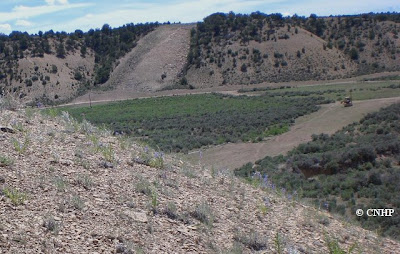
A rare plant, Penstemon fremontii var. glabrescens (Fremont's beardtongue), sports small blue flowers in the foreground. The population is bisected by the pipeline in the center of the photo. This photo was taken in the Piceance Basin (Rio Blanco County, CO) on June 9, 2010.

Duane Zavadil from the Bill Barrett Corporation spoke about a new approach to compliance with National Environmental Policy Act (NEPA) regulations that the company piloted in the Nine Mile Canyon area of Utah. The Denver-based company reached agreements with the Southern Utah Wilderness Alliance on a drilling plan. The resulting pact was then signed by the BLM. The initial proposal called for 538 well pads. The final plan includes 120 pads.

The Intermountain Oil and Gas BMP Project is a new website hosted by the Natural Resources Law Center at the University of Colorado Law School. The website houses a free, searchable Best Management Practices (BMP) database. The database includes both mandatory and voluntary BMPs recommended for responsible resource management in the Intermountain West, including some written by the Colorado Rare Plant Conservation Initiative.

While innovations that reduce impacts to the landscape can help conserve rare plant populations, the impact of energy development on rare plants is not well understood and the effectiveness of many recommendations is unknown. Research and monitoring studies of rare plant populations are the only way to fill these knowledge gaps.

Thursday, June 10, 2010

Biodiversity without boundaries conference in Austin, TX

CNHP Botanist Susan Panjabi and Director Dave Anderson attended the Biodiversity Without Boundaries Conference, hosted by NatureServe, in Austin Texas in April. Susan gave a presentation on the Rare Plant Conservation Initiative and Dave gave a panel presentation on the Biodiversity Scorecard Project. It was a great chance to get to know others from around the network of heritage programs! And they had a great time exploring Austin too.

One thing Austin is famous for (besides its music scene) are its bats! The evening emergence of 1-2 million Brazilian Free Tailed Bats from the bridge on Congress Avenue has become famous and hundreds of people come to see this spectacle every night.

bats flying from under bridge
Bats emerging from the Congress Avenue Bridge in Austin

About an hour south of Austin is Bracken Cave. This cave is home to over 20 million Brazilian Free Tailed Bats and is the single biggest congregation of mammals on Earth (except perhaps Tokyo?).

lots of bats
The bat exodus from Bracken Cave on April 25, 2010

This cave is on private property that is owned by Bat Conservation International who carefully manages the property and controls visitation. The bat emergence from this cave is one of the most spectacular natural phenomena in the animal world. Below is a video of the emergence on April 25th, taken by Dave Anderson:

Thursday, September 3, 2009

Collaborative Conservation Conference Sept. 8-11

Our friends at the Center for Collaborative Conservation are holding a conference titled Bridging the Gap: Collaborative Conservation from the Ground Up. The conference will be at Colorado State University from September 8-11 (next week!), and will focus on the power of pooling resources for effective conservation.

A number of CNHP folks will be there. If you're going, don't miss Susan Panjabi and Jessica Parker with their poster on the Rare Plant Conservation Initiative.