
We are looking for up to 12 seasonal zoology field technicians to survey for mammals, amphibians, birds, and invertebrates this summer. Sites will be in various locations throughout the state. These positions will require extensive travel, some camping, and long days in the field. These positions may also involve properly collecting and preparing specimens for identification when appropriate.
Position timeframe: Approximately May 1, 2010 through October 31, 2010 and will vary depending upon project.
First consideration of applicants will begin March 31, 2010, but positions will remain open until filled. For more information about these positions and how to apply, please see the announcement on the Employment and Volunteering page of our website.
Thursday, March 25, 2010


Tuesday, March 23, 2010
Field techniques - Frequency
CNHP ecologists use frequency of occurrence as a measure of plant community composition, especially if we want to know how the community is changing over time.

Frequency is usually expressed as a percentage, such as the percent of all plots in which a species is present, or the percent of cells in a grid that contain the species. It is a presence/absence measurement, and does not reflect the number of individuals or the area they cover. A little reflection tells us that frequency is highly dependent on the size of the area being observed – if our sample frame is the size of the earth, every species has a frequency of 100%!
Since we don't always know in advance what size frame will be appropriate for detecting changes in species frequencies, and because some species are much bigger than others, it is common to use a "nested" frequency frame like this, placed at many different locations in the area being studied:

This frame can easily be made out of plastic pipe and elbow fittings. Divisions can be marked with strings, or marks along the frame edge. To read the frame, record a 1 if the species is in the smallest square, a 2 if it is in the 1/10th m square but not the 1/100th, and a 3 if it is only in the largest square outside the other two squares. A species that gets a 1 is present in all three frame sizes, but a species with a 3 is only present at the largest frame size. Calculate the percent of "present" frames for each species at each size frame. To detect change over time, a frame size that gives a percentage between 20 and 80 is best.


Reading a frequency frame placed along a transect.
Frequency is usually expressed as a percentage, such as the percent of all plots in which a species is present, or the percent of cells in a grid that contain the species. It is a presence/absence measurement, and does not reflect the number of individuals or the area they cover. A little reflection tells us that frequency is highly dependent on the size of the area being observed – if our sample frame is the size of the earth, every species has a frequency of 100%!
Since we don't always know in advance what size frame will be appropriate for detecting changes in species frequencies, and because some species are much bigger than others, it is common to use a "nested" frequency frame like this, placed at many different locations in the area being studied:

This frame can easily be made out of plastic pipe and elbow fittings. Divisions can be marked with strings, or marks along the frame edge. To read the frame, record a 1 if the species is in the smallest square, a 2 if it is in the 1/10th m square but not the 1/100th, and a 3 if it is only in the largest square outside the other two squares. A species that gets a 1 is present in all three frame sizes, but a species with a 3 is only present at the largest frame size. Calculate the percent of "present" frames for each species at each size frame. To detect change over time, a frame size that gives a percentage between 20 and 80 is best.

Quiz time! Assuming the nested corner is upper left in the photo,
is the dog is a 1, 2, or a 3?
is the dog is a 1, 2, or a 3?
(A: we're sampling plants here, shoo!)
Thursday, March 18, 2010
2009 Southeast Colorado survey report now available

The most intact portion of the Central Shortgrass Prairie ecoregion is in southeast Colorado, in private ownership. In 2007 and 2009, landowners requested biological inventories of their properties by the Colorado Natural Heritage Program, so the landowners might obtain data pertinent to their stewardship, future management decisions, and ecosystem credit values.
This study was made possible with support from Great Outdoors Colorado, Colorado Division of Wildlife, Colorado Cattlemen’s Agricultural Land Trust, Colorado State Land Board, The Nature Conservancy, Natural Resource Conservation Service, and private landowners.

Our surveys have confirmed that southeast Colorado is a biological hotspot. CNHP mapped over 2400 mapped locations of 41 rare species of animals, 36 of rare plants, and 46 plant communities of conservation concern.
The results of the 2009 surveys are now available in the report Southeastern Colorado Survey of Critical Biological Resources 2009 Addendum to the 2007 Survey. Both this and the report for the 2007 surveys are available on the Documents and Reports page of our website.
Tuesday, March 16, 2010
Site Profile: Troublesome Creek, Grand County
B1: Outstanding Biodiversity Significance

This site was visited during 2005 as part of the Grand County Inventory. Troublesome Creek joins the Colorado River east of Kremling. The site is dominated by the sandstones and siltstones of the Troublesome Formation, which are generally sparsely vegetated. These fine-textured, grayish-brown soils may not look like much, but are home to two Grand County endemic plant species that are Federally Listed as Endangered: Penland beardtongue (Penstemon penlandii) and Osterhout milkvetch (Astragalus osterhoutii), as well as the regional endemic dog parsley (Aletes nuttallii).

This site includes all known occurrences for Penland beardtongue. Due to the concentration of globally critically imperiled (G1/S1) plants, this site is of outstanding biodiversity value, in essence irreplaceable.


This site was visited during 2005 as part of the Grand County Inventory. Troublesome Creek joins the Colorado River east of Kremling. The site is dominated by the sandstones and siltstones of the Troublesome Formation, which are generally sparsely vegetated. These fine-textured, grayish-brown soils may not look like much, but are home to two Grand County endemic plant species that are Federally Listed as Endangered: Penland beardtongue (Penstemon penlandii) and Osterhout milkvetch (Astragalus osterhoutii), as well as the regional endemic dog parsley (Aletes nuttallii).

Osterhout milkvetch (Astragalus osterhoutii)
This site includes all known occurrences for Penland beardtongue. Due to the concentration of globally critically imperiled (G1/S1) plants, this site is of outstanding biodiversity value, in essence irreplaceable.

Penland beardtongue (Penstemon penlandii)
Thursday, March 11, 2010
Doubling our assets
CNHP has been busy in the 21st century! Over the past decade, the number of mapped locations of rare plants, animals and communities nearly doubled in our BIOTICS database, jumping from 11,577 to 23,068 mapped locations. That’s a lot of ground covered and a lot of digitizing.
A big thanks to all of our partners who made this possible by funding field work, submitting data and supporting our mission.
A big thanks to all of our partners who made this possible by funding field work, submitting data and supporting our mission.
Tuesday, March 9, 2010
6-8 new Field Technician positions now open
The Center for Environmental Management of Military Lands together with CNHP anticipate a need for up to 8 technicians for field work at two project sites along the Upper Missouri River in Montana. The work requires field botany or field ecology skills, GPS, and map reading and navigation skills. Knowledge of plant taxonomy and species identification is required; experience identifying flora of the northwestern Great Plains is beneficial.
Successful applicants will sample vegetation communities on lands surrounding two US Army Corps of Engineer reservoirs. Field technicians will navigate to remote plot locations via foot, boat, and/or automobile and document plant community and environmental characteristics using maps, imagery, GPS, and vegetation keys.
Anticipated position timeframe: June-October, 2010.
These positions are open until filled. For more information about these positions and how to apply, please see the announcement on the Employment and Volunteering page of our website.
Successful applicants will sample vegetation communities on lands surrounding two US Army Corps of Engineer reservoirs. Field technicians will navigate to remote plot locations via foot, boat, and/or automobile and document plant community and environmental characteristics using maps, imagery, GPS, and vegetation keys.
Anticipated position timeframe: June-October, 2010.
These positions are open until filled. For more information about these positions and how to apply, please see the announcement on the Employment and Volunteering page of our website.
Thursday, March 4, 2010
Update on Natural Heritage Methodology Training

Teleconferenced participants in VA and MA watch and listen to a presentation in Colorado.
We're on day 3 of our 4 day Natural Heritage Methodology training session, here in Fort Collins and concurrently in Virginia and Massachusetts. There are 32 participants, two thirds of which are attending here at CNHP's office in Colorado State University. We are teleconferenced in with the other two locations, so that trainers can give their talks at any of the 3 locations, and all attendees can participate equally.

Lessons in basic methodology were punctuated by specific examples and exercises.
In addition to participants from CNHP, attendees represent California Academy of Sciences, California Dept. of Fish and Game, Lousiana Natural Heritage Program, Maine Natural Areas Program, Michigan Natural Features Inventory, Mississippi Museum of Natural Science/Heritage Program, Montana Natural Heritage Program, National Park Service, NatureServe, Nebraska Game and Parks Commission, New York Natural Heritage Program, Parks Canada, Tennessee Valley Authority, The Nature Conservancy (Texas Chapter), US Fish and Wildlife Service, Virginia Division of Natural Heritage, Western Timberland Research, Wisconsin Dept. of Natural Resources, and the Wyoming Natural Diversity Database.

Smiling participants here in Colorado.

Breakout session to apply what we have learned.
It has been long days full of detailed information and breakout discussions and exercises. Yesterday, we took a quick yoga break, and today we hope to break early to take field trips. Our field trip here is to the Soapstone Prairie Natural Area.

Yoga Break!
Tuesday, March 2, 2010
Colorado tarantula
Did you know that Colorado has its own species of tarantula? CNHP ecologist Renée Rondeau took these photos of our endemic tarantula, Aphonopelma coloradanum, in Pueblo County last fall.
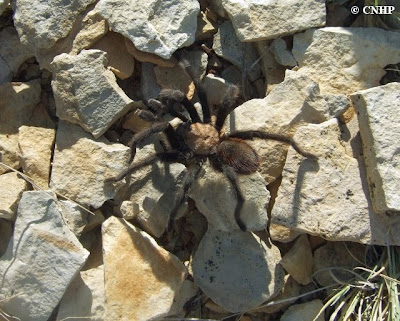
These large furry spiders may be seen in the southeastern corner of the state, as far north as Colorado Springs, especially during the mating season from late August through November. Most tarantulas out and about are mature males, looking for mature females.


Now, now, he's just as scared of you as you are of him.
These large furry spiders may be seen in the southeastern corner of the state, as far north as Colorado Springs, especially during the mating season from late August through November. Most tarantulas out and about are mature males, looking for mature females.

Gee, Renée, what's that moving around in your backpack?
Subscribe to:
Posts (Atom)

