Tuesday, December 6, 2011

Botany A to Z: Astragalus

By Karin Decker
is for Astragalus
I have no idea why this is, but there are more rare plant species names in the first third of the alphabet than in the remaining two thirds. The letters A through G account for half of all plant species tracked by CNHP.  By far the most frequent genus name on the tracking list is Astragalus, the milkvetches, which are members of the pea family.

Astragalus rules! (thanks to www.wordle.net)
Dr. Rupert Barneby provided a wealth of information on this genus in his 1964 two-volume Atlas of North American Astragalus.  Duane Isely and Stanley Welsh have also published more recent comprehensive work on the genus. The origin of the generic name Astragalus is thought to be the Greek word astragalos, meaning ankle-bone.  These bones were apparently once used as a form of dice, and the rattle of dry seeds in the pod of Astragalus mimicked the sound of dice in the cup.
Worldwide, there are perhaps up to 2000 species of Astragalus, and they are especially common in southwestern Asia. Western North America, including Colorado, is also a center of diversity for this genus.  Our state is home to more than 150 different species of milkvetch; CNHP tracks 45 of these species (see map below).
Most of our species are found on the west slope; species on the eastern plains are common in states further east, but are at the edge of their distribution in Colorado. Ten Astragalus species are endemic to Colorado – found nowhere else in the world.
Documented locations of rare Astragalus species in Colorado. Endemic species are colored and labeled, non-endemic are gray.

Although most species of Astragalus have fairly showy flowers with the wings and keel that are typical of pea flowers, it is by their fruits that you will know them. Barneby noted that “Perhaps the most remarkable single characteristic of the genus Astragalus as a whole, and it is especially marked in North America, is that there are hardly two species, even very closely related, which do not differ one from another in form or structure of the fruit”.  This characteristic allows for easy description of individual species. Botanists scheduling their field trips are torn between the prospect of getting a pretty photo of a flowering Astragalus, and the need for mature fruits to make sure they’ve got the correct species. Sometimes you luck out and get both.
Astragalus debequaeus

Astragalus debequaeus, closeup of flowers.

Astragalus debequaeus, closeup of fruits.

Thursday, December 1, 2011

Potential ACEC designation for three endangered plant species

By Bernadette Kuhn

The Kremmling BLM office has released a Draft Resource Management Plan that includes proposed ACEC (Area of Critical Environmental Concern) designations for three federally endangered plant species: Astragalus osterhoutii, Penstemon penlandii, and Phacelia formosula. An ACEC is a designation that highlights areas where special management attention is needed to protect and prevent irreparable damage to important resources, including rare species.

The total number of proposed acres for ACEC designation ranges from 516 to 9,250 acres, under four different alternatives. Comments are due by January 16, 2012. 


Astragalus osterhoutii (Osterhout milkvetch) is a beautiful, robust milkvetch. This narrow endemic is federally endangered. Its global distribution is limited to an estimated 800 acres in north central Colorado.

 
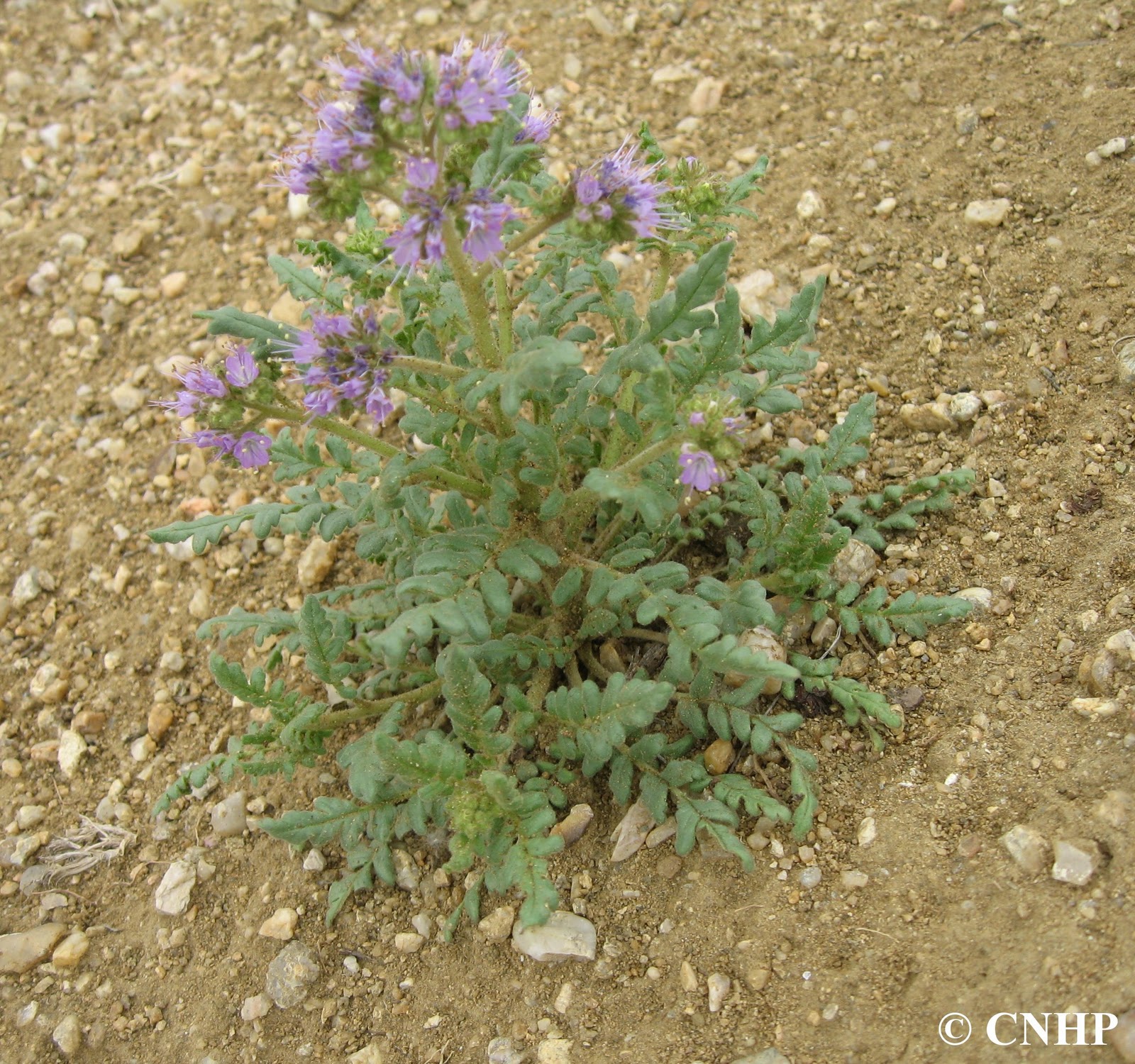
Phacelia formosula (North Park phacelia), a showy, purple-flowered member of Hydrophyllaceae, occurs on sandy bluffs in Jackson County. 

Penstemon penlandii (Penland's beardtongue) is known from two occurrences outside of Kremmling, Colorado.  This species is highly restricted to shales derived from the Troublesome Formation.

Tuesday, November 29, 2011

Ecological Systems: Sagebrush Shrublands


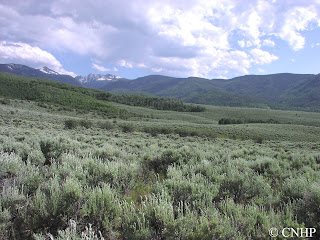
There are two major types of sagebrush ecological systems in Colorado: big sagebrush shrublands and montane sagebrush steppe. These shrublands occur throughout much of the western United States. Although they can be found on Colorado’s east slope, the largest occurrences are on the western slope. North Park, Middle Park, and the upper Gunnison Basin have extensive stands of sagebrush shrublands.

     Big sagebrush shrublands in western Colorado.

Big sagebrush shrublands are typically found in broad basins between mountain ranges, on plains and foothills. Big sagebrush shrublands are characterized by a dense stands of taller sagebrush species with a significant herbaceous understory, and are generally found at elevations from 5,000 to 7,500 feet. Taller shrubs distinguish the big sagebrush shrubland ecological system from the montane sagebrush steppe shrublands, which are dominated by shorter sagebrush species.

Montane sagebrush, Gunnison County, Colorado.

Montane sagebrush steppe primarily occurs on ridges, near flat ridgetops, and mountain slopes. Montane sagebrush stands are usually found at elevations from 7,000 to 10,000 feet, often adjacent to the lower elevation big sagebrush shrublands.

Sagebrush shrublands provide food and shelter for many small mammal and bird species. The most significant at-risk animal species in Colorado’s sagebrush ecosystem is the Gunnison Sage Grouse, ranked “critically imperiled” (G1S1) by the Colorado Natural Heritage Program, and listed as a Tier 1 Species of Greatest Conservation need by the Colorado Division of Wildlife. Other Tier 1 Species of Greatest Conservation Need that are found exclusively (or almost exclusively) in sagebrush habitats are Greater Sage Grouse, Brewer’s Sparrow and Sage Sparrow. In addition, several of Colorado’s rarest plants are found primarily in sagebrush habitats. These include the federally listed (Endangered) Osterhout’s milkvetch, as well as several other globally rare members of the milkvetch family (Gunnison milkvetch, violet milkvetch, and skiff milkvetch). Other rare Colorado plants that are most commonly found in sagebrush habitats are the globally rare narrow-leaf evening primrose, Bessey locoweed, Fremont’s beardtongue, and Harrington’s beardtongue.

Many of Colorado’s sagebrush shrublands are vulnerable to changes induced by domestic livestock grazing. Over the past century the condition of much of Colorado’s sagebrush shrubland has been degraded due to fire suppression and heavy livestock grazing. Although many livestock operations are now more sensitive in their treatment of sagebrush habitats than they once were, recovery in these systems is slow. Furthermore, many remaining sagebrush patches are now being fragmented by fast-paced and widespread energy development.

Overall biodiversity, threat, and protection status scores for sagebrush shrubland in Colorado.

 A "windrose" graph depicting sagebrush status for individual scoring factors.

Wednesday, November 23, 2011

Cool Climate Collaboration

For those who are interested in climate data, the Center for Snow & Avalanche Studies has a nice website with data from their study area in the San Juan Mountains.  Their “near-real time mountain system monitoring data” provides a continuous picture of conditions at the alpine plots in the Senator Beck Basin area. Check out the graphs presenting seven years worth of climate data! CNHP’s Peggy Lyon worked with CSAS and Julie Crawford to produce a baseline study of the plant communities in the area that is available on the site. CSAS is also engaged in fascinating research on the effects of dust-on-snow on Colorado’s mountain snowpack.
Vegetation transect in Senator Beck Basin.

Thursday, November 17, 2011

Interesting International Interdisciplinary Internship

For the last three years, CSU's Human Dimensions of Natural Resources Department (HDNR) has been developing and implementing a program of collaborative capacity building efforts with the Wildlife Institute of India (WII). A formal partnership was established between CSU and WII through the signing of an International Memorandum of Understanding in 2008 to carry out research and training initiatives focused on enhancing protected area management, mitigation of human-wildlife conflicts, and the incorporation of social sciences in conservation planning and decision making.

An internship opportunity was developed this past summer for Vinamra Mathur, a student from India who is currently an honors undergraduate in the Environmental Science Program at University of Manchester, UK. The goal of the internship was to provide opportunities for Vinamra to develop skills and experience in several aspects of environmental science as a volunteer intern working on projects for both HDNR and CNHP during the summer of 2011.

Vinamra with his improvised raingear and ready for anything. Photo by David G. Anderson.

Vinamra spent several weeks assisting CNHP Ecologist Joe Stevens and Botanist Bernadette Kuhn and their field crews with vegetation sampling and mapping in Rocky Mountain National Park in Colorado and Yellowstone National Park and Bighorn Canyon Recreation Area in Wyoming as a part of our GLORIA project. He then spent some time at the US Air Force Academy with CNHP Director Dave Anderson, where he saw some of the rarest plants in the area. Another day was spent with CNHP Botanist Pam Smith on surveys of rare plants and plant communities within Jefferson County.

Vinamra then spent a week with CNHP's wetland field sampling crew, led by Laurie Gilligan and Erick Carlson, sampling wetlands all across the state. On this trip Vinamra learned wetland sampling methods that are being used by CNHP as partners in EPA's National Wetland Condition Assessment. Another three days were spent in the field with John Sovell, CNHP Zoologist monitoring the Pawnee Montane Skipper. The Pawnee Montane Skipper is a federally threatened species of butterfly that occurs only in the South Platte River drainage of Colorado. In partnership with the USDA Forest Service and the US Fish and Wildlife Service, CNHP has been monitoring this species since 2004.

Measuring weeds at the U.S. Air Force Academy. Photo by David G. Anderson.

After nearly 2 months in the field with CNHP, Vinamra spent some time in and around Fort Collins working with HDNR faculty and staff, learning about basic concepts and methodologies for examining the social aspects of natural resource management.

For all the details of Vinamra's summer internship at CSU, check out the full article in the Warner College of Natural Resources fall newsletter.

Tuesday, November 8, 2011

Artistic Aquatic Entomologists - Assemble!

(Forgive the alliteration, end-of-year deadlines will do that to a person.)

For a bit of local news, the City of Fort Collins is holding an Art in Public Places design contest to help raise public awareness to the relationship between storm drains and environmental health. The stormwater drainage network within Fort Collins drains directly into the Cache La Poudre River, so that what gets dumped into a street gutter or storm drain has a direct impact on water quality and the health of aquatic systems.

A stonefly nymph from our neck of the woods (Larimer County, CO). Photo by Georgia Doyle.

If you are artistic and like aquatic insects, here's your chance to make a difference! The contest runs through January 3, 2012, with the theme of aquatic insects in our watershed and how they help determine water quality. The winner receives an honorarium, and then more than 75 manhole covers and 3,000 storm drain markers will be replaced over the next 5 years by new sustainable die-cast markers featuring the winning artwork.

For more information, see the full announcement from the City.

Friday, November 4, 2011

Nine new Rare Plant Conservation Initiative reports available

Ipomopsis polyantha. Photo by David G. Anderson.

Phew! In a flurry of activity, CNHP and TNC Botanists and Conservation Planners have finalized a whopping 9 new reports for both statewide and local Conservation Action Plans as a part of the collaborative Colorado Rare Plant Conservation Initiative.

The reports are:
  • Arkansas Valley Action Plan 2011 Update
  • Big Gypsum Valley and Dry Creek Basin Preliminary Action Plan
  • Colorado Wildlife Action Plan: proposed rare plant addendum
  • Gateway Preliminary Action Plan
  • Middle Park Action Plan 2011 Update
  • North Park Action Plan 2011 Update
  • Pagosa Springs Action Plan 2011 Update
  • Piceance Basin Action Plan 2011 Update
  • Plateau Creek and Miramonte Reservoir West Preliminary Action Plan
Each report is available in PDF form from our Documents and Reports page, as well as from our Botany Team page.

Wednesday, November 2, 2011

New Wetland journal article

Dr. David Cooper and Joanna taking data in a large basin site south of Yellowstone Lake.

CNHP Wetland Ecologist Joanna Lemly has had her graduate thesis work on fens in Yellowstone National Park published in the journal Botany.

The paper:
Lemly, J.M. and D.J. Cooper. 2011. Multiscale factors control community and species distribution in mountain peatlands. Botany 89: 689-713.

Joanna assembling an 8 foot peat probe, though she often found that the peat went deeper than the probe!

Fens are peat-forming wetlands that are fairly rare in the western U.S., but contribute significantly to regional biodiversity, supporting a number of rare plant and animal species. Joanna's study characterized the vegetation composition of fens in Yellowstone and analyzed the various environmental factors that influence them.


Congratulations Joanna!