Wednesday, January 18, 2012

Ecological Systems: Southern Rocky Mountain Pinyon-Juniper


The Southern Rocky Mountain Pinyon-Juniper ecological system is similar to the Colorado Plateau Pinyon-Juniper system, but with a more restricted distribution in south central Colorado. In Colorado, the southern Rocky Mountain pinyon-juniper woodlands are found in the south central part of the state, around the San Luis Valley, southern mountain front east to Mesa de Maya, and north to the Arkansas River Valley and Palmer divide. Elevations range from about 5,000 to 9,000 feet. Pinyon-juniper also occurs in a limited distribution on the eastern plains near the Purgatoire River. These are open woodlands of warm, dry sites on mountain slopes, mesas, plateaus, and ridges. Pinyon pine and/or one-seed juniper dominate the tree layer, and Rocky Mountain juniper may be present at higher elevations. In the canyons and tablelands to the east, pinyon is absent, and this system is replaced by the Southern Rocky Mountain Juniper Woodland and Savanna system. Understory layers are variable and may be dominated by shrubs, grasses, sparse vegetation, or bare ground.

Southern Rocky Mountain pinyon-juniper covers some 1.25 million acres in Colorado. Ownership is divided about equally between private and public ownership, with the Bureau of Land Management responsible for the majority of federal holdings. Pinyon-juniper ecological systems have declined in both extent and quality compared to historic norms, although there are a number of very large patches remaining. Threats include urban development, recreation (especially motorized recreation), invasive species (most notably an increase in cheatgrass in the understory, which has led to increasing fire ignitions), and energy development.
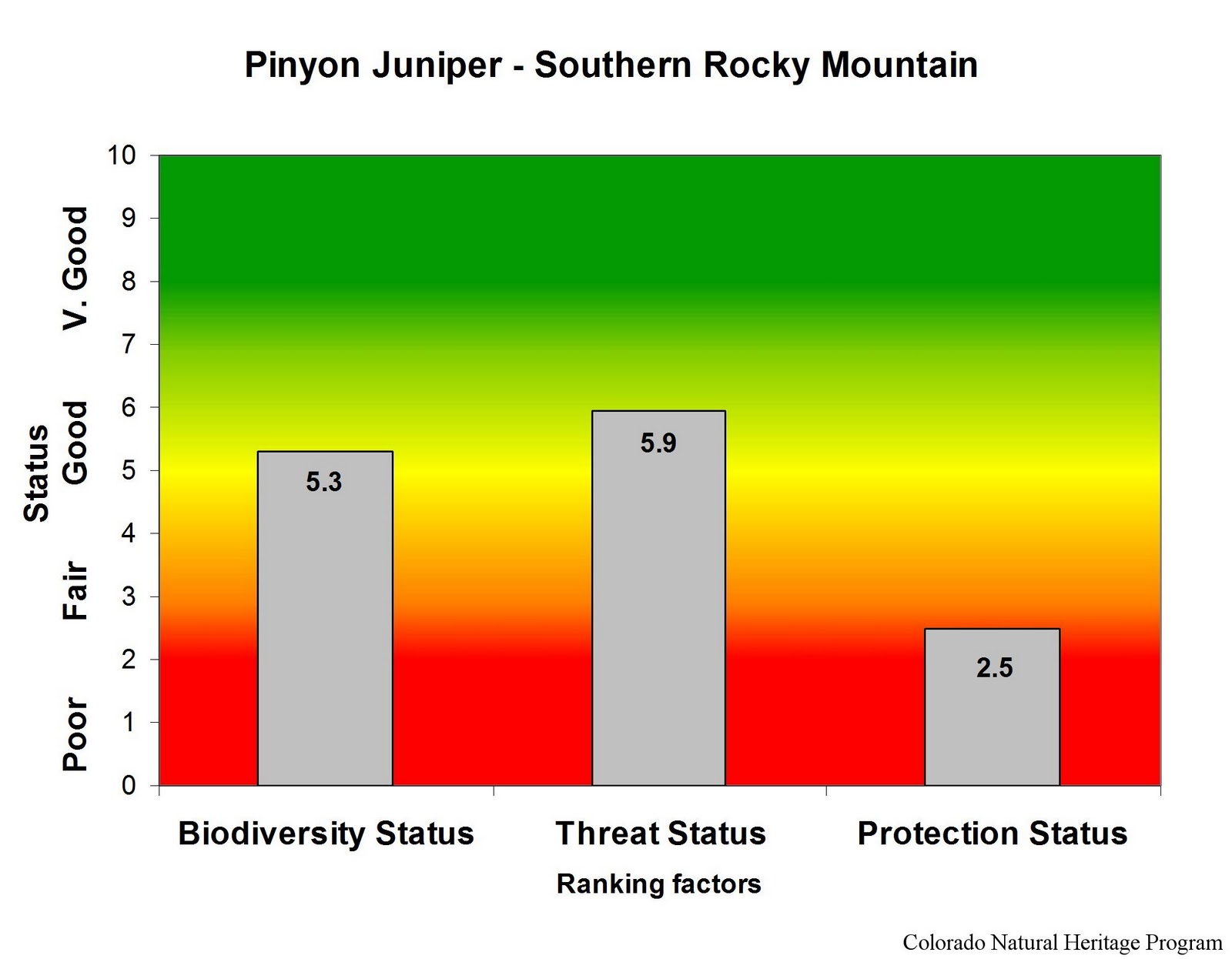

Overall biodiversity, threat, and protection status scores for
Colorado Plateau Pinyon-Juniper in Colorado.
 
 
 A "windrose" graph depicting Colorado Plateau Pinyon-Juniper status for individual scoring factors.

Tuesday, January 10, 2012

Botany A to Z: Cirsium

by Karin Decker

is for Cirsium

Cirsiums are thistles, and are members of the sunflower family (Asteraceae). Although the thistle is the national emblem of Scotland, most people probably regard them as unwelcome pest plants. You are probably familiar with troublesome weed species like Scotch thistle, Canada thistle, and musk thistle. These non-native thistles are often able to grow and spread into disturbed environments where their natural predators are absent, and may form large single-species stands that crowd out other plants.

Scotch thistle (Onopordum acanthium), a long way from Scotland.
“What are you looking at me for? I’m not even a Cirsium!”


Thick stand of Canada thistle (Cirsium arvense).
Who wants to go pick up the other end of the measuring tape?

Native thistle species do not typically pose problems because they are co-evolved members of naturally occuring plant communities, and are kept in check by natural processes. Colorado has several dozen native species of Cirsium, and most are fairly common. Unfortunately, all of our native thistles are potentially threatened by being mistaken for non-natives during weed control efforts.

Mountain thistle (Cirsium scopulorum), thriving amidst the talus and columbines.


Barnaby's thistle (Cirsium barnabyi)

CNHP keeps documented location records for three of Colorado’s rarest Cirsium species: Ownbey’s thistle (Cirsium ownbeyi), adobe thistle (Cirsium perplexans), and mountain-slope thistle (Cirsium scapanolepis).

Adobe thistle

Tuesday, January 3, 2012

Ecological Systems: Lodgepole Pine


In Colorado, the lodgepole pine ecological system is widespread between 8,000-10,000 feet in elevation, on gentle to steep slopes of the Rocky Mountains in the northern part of the state.  Stands may be pure lodgepole pine, or mixed with other conifer species. Following stand-replacing fires, lodgepole pine rapidly colonizes and develops into dense, even-aged stands (sometimes referred to as “dog hair” stands).  Lodgepole pine forests typically have shrub, grass, or barren understories, sometimes intermingled with aspen.  Shrub and groundcover layers are often sparse in lodgepole pine forests. Diversity of plant species is also low, perhaps as a result of the uniform age and dense canopy of many stands.
Lodgepole forests cover more than two million acres in Colorado. Although these forests are common across Colorado, most are experiencing widespread damage from a severe outbreak of mountain pine beetle. The pine beetle is a native species, and periodic outbreaks of this insect are part of the natural cycle that maintains our mountain forests.  Climate change, however, may enhance the scope and severity of the outbreaks. 
Lodgepole pine stands hit by the mountain pine beetle.
Common mammal species in these forests include the pine squirrel (also called chickaree), porcupine, mule deer, and elk. Typical birds are the Mountain Chickadee, Pine Siskin, Ruby-crowned Kinglet, and Yellow-rumped Warbler. Rarer species include the Three-toed Woodpecker and Williamson’s Sapsucker. These forests are used occasionally by lynx.
A porcupine contemplating the status of lodgepole forests.
Most of our lodgepole forests are on federally owned lands managed by the U.S. Forest Service, Bureau of Land Management, or National Park Service. Most are not completely within wilderness areas, although they may be present along the boundaries of these areas. Lodgepole pine forests in Colorado generally have good conservation status. Natural processes such as fire and pine beetle infestation are the most obvious impacts to these forests. Fire suppression and logging have affected some areas.
Overall biodiversity, threat, and protection status scores for lodgepole pine in Colorado.


 A "windrose" graph depicting lodgepole status for individual scoring factors.

Thursday, December 22, 2011

Happy Holidays!

It's getting pretty quiet around CNHP at the moment, as we all head home for the end of the year.

Best wishes from all of us to all of you for happy holidays and a great new year - see you then!

Winter scene near Charles Peak, Eagle County, Colorado.
Photo by Renée Rondeau
(click on photo to enlarge)

Wednesday, December 14, 2011

Botany A to Z: Brassicaceae

By Karin Decker
is for Brassicaceae
Brassicaceae is the third most frequent family on the list of rare plants tracked by CNHP. This is the mustard family, formerly known as Cruciferae, for the cross-shaped, four-petaled flowers that distinguish its member species. Most people are familiar with common cultivated species in this family including broccoli, cabbage, cauliflower, and of course, that ubiquitous condiment, mustard.

CNHP tracks more than 50 rare species in the mustard family, including what may be the rarest of all Colorado plants, Draba weberi. Our rare species are found in many different habitats, from lower elevations on the plains up to the highest alpine areas.

Most members of the mustard family are small and not particularly showy unless accompanied by several thousand of their closest relatives. 

A couple hundred individuals of Lesquerella congesta (Dudley Bluffs bladderpod), trying to put on a show. Not really working, is it.

One exception is the desert prince’s plume, Stanleya pinnata, a common component of the spring flower show in desert areas.

Stanleya pinnata
showing off. 
As with the milkvetch genus (Astragalus), mustard family species are identified by the characteristics of their fruits. In fact, fruits of this family have a special name: silique. So, if you want to key out a mustard, remember to get a sample of the fruits or you won’t get far.

Fendler's bladderpod (Lesquerella fendleri), with a nice view of both the four-petaled flower and the inflated silique. 

Dudley Bluffs bladderpod with a fine crop of fruit - the whole plant is about 2 inches across.  Hard to believe something this small can make so many fruits!
Not all mustard-family species have yellow flowers - we just didn't have many good pictures of species with other colors, which include white, purple or pink flowers.

Thursday, December 8, 2011

2011 Wetland Condition Assessments – Successfully Profiling a Broad Range of Wetland Conditions

by Laurie Gilligan

During the 2011 field season, crews from CNHP Ecology Team successfully conducted 82 wetland condition assessment surveys in three project areas for three different objectives:
  1. 34 wetlands were assessed in the northern Front Range to inform wetland mitigation decisions along the Front Range corridor,
  2. 17 wetlands were assessed in western Routt National Forest for targeted monitoring and resampling of riparian wetlands, and
  3. 31 wetlands were assessed throughout Colorado and Wyoming as part of the first National Wetland Condition Assessment.
These assessments included detailed vegetation surveys to calculate a floristic quality index and an assessment of each site’s landscape context, physiochemistry, and hydrologic integrity. The 2011 surveys spanned a wide range of wetland types and condition. The results will be compiled into reports to inform land managers and other stakeholders about the condition of their valued aquatic resources, leading to more effective conservation and management.
A typical site in the Front Range was located adjacent to urban influences, such as oil and gas well platforms, center-pivot irrigation crop fields, or along reservoir shores within suburban housing developments. Nearly one-half (15 of 34) of the wetlands surveyed using a randomized study design were dominated by cattail species (Typha latifolia and/or T. angustifolia). Noxious species were recorded in all but two of the wetlands surveyed. Dominance of cattail is indicative of high nutrient conditions, but wetlands are valued for their ability to filter and reduce nutrient loads before polluted runoff waters from urban areas return to Colorado’s rivers. These wetlands were hard-working!

A marsh wetland in Weld County, Colorado.
In contrast, a number of the wetlands surveyed in the Routt National Forest and National Wetland Condition Assessment projects were riparian shrublands supporting plants indicative of higher ecological integrity. As a wetland contains higher species diversity, greater vertical structure, and more native plant species, the wetlands themselves can support more diverse wildlife habitat. As an example, the Grizzly Creek Park site (shown below) was a mosaic of Wolf's willow (Salix wolfii) interspersed with hillside seeps (the brightest green areas) dominated by mixed sedge (Carex) species. These wetlands were prioritized for survey in part to record baseline data near beetle-killed forests that may be logged in the future.
 
A riparian shrubland wetland site from Grizzly Creek Park in Routt National Forest.

Tuesday, December 6, 2011

Botany A to Z: Astragalus

By Karin Decker
is for Astragalus
I have no idea why this is, but there are more rare plant species names in the first third of the alphabet than in the remaining two thirds. The letters A through G account for half of all plant species tracked by CNHP.  By far the most frequent genus name on the tracking list is Astragalus, the milkvetches, which are members of the pea family.

Astragalus rules! (thanks to www.wordle.net)
Dr. Rupert Barneby provided a wealth of information on this genus in his 1964 two-volume Atlas of North American Astragalus.  Duane Isely and Stanley Welsh have also published more recent comprehensive work on the genus. The origin of the generic name Astragalus is thought to be the Greek word astragalos, meaning ankle-bone.  These bones were apparently once used as a form of dice, and the rattle of dry seeds in the pod of Astragalus mimicked the sound of dice in the cup.
Worldwide, there are perhaps up to 2000 species of Astragalus, and they are especially common in southwestern Asia. Western North America, including Colorado, is also a center of diversity for this genus.  Our state is home to more than 150 different species of milkvetch; CNHP tracks 45 of these species (see map below).
Most of our species are found on the west slope; species on the eastern plains are common in states further east, but are at the edge of their distribution in Colorado. Ten Astragalus species are endemic to Colorado – found nowhere else in the world.
Documented locations of rare Astragalus species in Colorado. Endemic species are colored and labeled, non-endemic are gray.

Although most species of Astragalus have fairly showy flowers with the wings and keel that are typical of pea flowers, it is by their fruits that you will know them. Barneby noted that “Perhaps the most remarkable single characteristic of the genus Astragalus as a whole, and it is especially marked in North America, is that there are hardly two species, even very closely related, which do not differ one from another in form or structure of the fruit”.  This characteristic allows for easy description of individual species. Botanists scheduling their field trips are torn between the prospect of getting a pretty photo of a flowering Astragalus, and the need for mature fruits to make sure they’ve got the correct species. Sometimes you luck out and get both.
Astragalus debequaeus

Astragalus debequaeus, closeup of flowers.

Astragalus debequaeus, closeup of fruits.

Thursday, December 1, 2011

Potential ACEC designation for three endangered plant species

By Bernadette Kuhn

The Kremmling BLM office has released a Draft Resource Management Plan that includes proposed ACEC (Area of Critical Environmental Concern) designations for three federally endangered plant species: Astragalus osterhoutii, Penstemon penlandii, and Phacelia formosula. An ACEC is a designation that highlights areas where special management attention is needed to protect and prevent irreparable damage to important resources, including rare species.

The total number of proposed acres for ACEC designation ranges from 516 to 9,250 acres, under four different alternatives. Comments are due by January 16, 2012. 


Astragalus osterhoutii (Osterhout milkvetch) is a beautiful, robust milkvetch. This narrow endemic is federally endangered. Its global distribution is limited to an estimated 800 acres in north central Colorado.

 
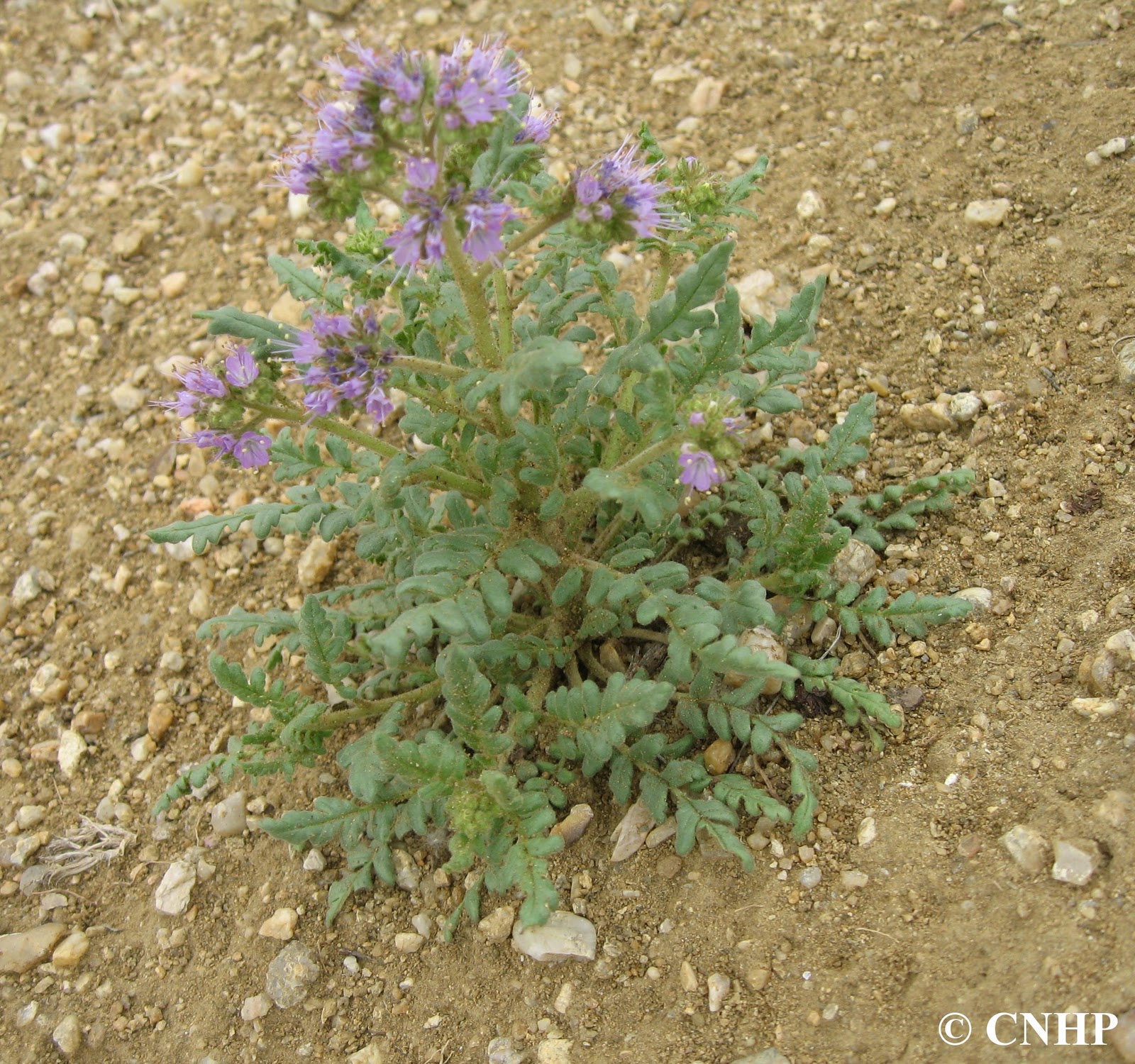
Phacelia formosula (North Park phacelia), a showy, purple-flowered member of Hydrophyllaceae, occurs on sandy bluffs in Jackson County. 

Penstemon penlandii (Penland's beardtongue) is known from two occurrences outside of Kremmling, Colorado.  This species is highly restricted to shales derived from the Troublesome Formation.