Thursday, June 5, 2014

Common Wetland Plants of Colorado’s Eastern Plains: A Pocket Guide

CNHP is excited to announce the release of the Common Wetland Plants of Colorado’s Eastern Plains: A Pocket Guide.  The pocket guide is a complimentary publication to the comprehensive Field Guide to Colorado’s Wetland Plants. The Pocket Guide highlights common wetland plants, both native and non-native located within the Eastern Plains. It is designed to help landowners and other wetland managers correctly identify common wetland plants, manage for preferred species, and control noxious ones.

Cover photo: a playa on the plains

The Pocket Guide contains 119 species with 6 key characteristics (with bolded highlights of diagnostic characters), similar species, habitat and ecology comments, and management comments.

Sample page from the pocket guide

This project was made possible with an U.S. EPA, Region 8, Wetlands Program Development Grant with in-kind match from the Colorado Parks and Wildlife Wetland Program and Colorado State University. The Pocket Guide is available for free from CNHP or can be mailed for $6.00 shipping and handling cost.  One can order from the CNHP Wetland Information Center website here or contact Denise Culver (Denise.Culver@colostate.edu) for more information.

Tuesday, May 20, 2014

CNHP wins the 2014 Collaboration Award at the Biodiversity Without Boundaries Conference

This year’s Biodiversity Without Boundaries Conference was held in New Orleans April 6-10, and eight of our staff were able to attend this time, giving a wide range of presentations on our work while building connections with other members of the NatureServe Network. There were many highlights from this conference - it is always a place where we form new friendships and renew old ones, and become energized by learning about all the amazing things happening throughout the Network. Three of our staff also completed training in Leadership (Jeremy Sueltenfuss and Rob Schorr) and Natural Heritage Methodology (Bernadette Kuhn).

One of the most exciting highlights this year was receiving the Collaboration Award. This award is given to one program each year, who is selected based on nominations from other programs around the Network of 82 programs in Canada, the US, and Latin America, as well as NatureServe. CNHP was nominated for our collaborations with other programs and innovative partnerships for conservation. These contributions include our role with the US Section Council, our participation in the NatureServe Leadership Program, our lead role in crafting the NatureServe Network statement of shared goals and values, and our partnership with Odell Brewing Company to conserve the Hops Blue butterfly. Sabra Tonn, Program Supervisor for the Arizona Heritage Data Management System, was able to get ahold of a few of the last bottles of Celastrina, which Mary Klein, President and CEO of NatureServe, gave to each of the winners of the awards this year! So we enjoyed getting to taste this beer with others around the Network during the award ceremony.

Mary Klein, President and CEO of NatureServe, announcing the award winners at
Biodiversity Without Boundaries, sweetening the pot with
bottles of Celastrina for the award recipients. 

The other winners of awards this year were the New York Natural Heritage Program (Conservation Impact), and Michigan Natural Features Inventory (Scientific and Technological Achievement).

David Anderson, Director of CNHP (Collaboration Award),
DJ Evans, Director of the New York NHP (Conservation Impact Award),
and Brian Klatt, Director of the Michigan Natural Features Inventory
(Scientific and Technological Achievement Award).
We did not all plan to wear blue shirts!

It is such a huge honor to be recognized by our peers for our collaborations and partnerships. Because this award is based on cooperation, we really feel that it is as much a testament to our own collaborations as it is to those of the other members of the NatureServe Network, who have embraced so many challenges and opportunities with us in recent years. Being part of a network that is so deeply committed to the grand collective effort we make to conserve biodiversity is something that gives all of us a reason to go home from work feeling good about what we did each day! And we feel very fortunate to be able to draw so much inspiration from the NatureServe Network, and the partners that we work to assist every day.

Left to right: Bernadette Kuhn, Renee Rondeau, Jeremy Sueltenfuss, Susan Panjabi,
Rob Schorr, Jill Handwerk, Michael Menefee, David Anderson, Anibal Ramirez Soto
(Pronatura Veracruz, Mexico), and Mary Klein (President and CEO, NatureServe).

Check out the NatureServe press release about our award here!

Tuesday, May 6, 2014

Mapping Gopher Tortoise Burrows in Louisiana

By Bernadette Kuhn, CNHP Botanist

I recently had a chance to attend a NatureServe Core Methodology training just north of New Orleans, Louisiana. Keri Landry, a wildlife biologist from the Louisiana Natural Heritage Program, and Whitney Weber from NatureServe instructed our group on how to map element occurrences for animals. The training was held north of Covington, Louisiana in a longleaf pine forest that provides habitat for the gopher tortoise. Once a widely distributed in the southeastern U.S., this species is now listed as Threatened by the U.S. Fish and Wildlife Service in Alabama, Mississippi, and Louisiana. Gopher tortoise populations have declined throughout the southeast due to the loss of longleaf pine forests, disease, hunting, and forestry practices.

Our training group spent the morning mapping gopher tortoise burrows. Keri extended a tiny camera on a flexible hose down inside two of the burrows. The camera projected an image onto a small field laptop screen, and we were able to see two gopher tortoises hunkered down in their burrows.


Keri has a tortoise-in-tow that she uses for public outreach and education. She let our group spend a few minutes admiring him up close. We were also fortunate to see the state’s southernmost documented population of Orobanche uniflora, oneflowered broomrape. This plant species, although somewhat common in Colorado, is rare in the southeast and is tracked by the Lousiana Natural Heritage Program as a G5 S1. The botanists in the group gleefully helped the LNHP staff map new populations of the delicate, parasitic plant. We were all excited to learn new ways to collect field data for element occurrences through a hands-on session in a beautiful and diverse ecosystem. Thanks to the NatureServe staff, Keri, and Amy Jenkins (Florida Natural Heritage Program) for a great training day!

Monday, April 7, 2014

Rob Schorr wins 2014 CSU AP Star Award!

CNHP Zoologist Rob Schorr was the recipient of a CSU AP Star Award! The AP Star Award was created to express appreciation by recognizing the accomplishments of administrative professional (AP) employees who have demonstrated outstanding individual performance at CSU. The goal is to recognize AP’s who make a difference and “shine” in our CSU community.

CNHP Zoologist Rob Schorr accepts his 2014 CSU AP Star Award.
Rob has an acute gift for recognizing and seizing opportunities and he did just that when he presented his idea for a new Colorado brewed craft beer to Odell's Brewing Company which eventually came to market as “Celastrina Saison”. This name is based on the rare Hops Blue Butterfly (Celastrina humulus), which was the source of the inspiration which led to a highly successful and novel partnership between the CNHP and Odell's Brewing Company. In addition to the successful partnership, Odell’s pledged to provide $1.00 for each bottle of Celastrina sold to a fund that would go to CNHP to study the butterfly. Odell’s was so pleased with the sale of Celastrina and the outreach effort that they presented Rob with a check for $12,000 to support research and conservation of the Hop’s Blue. Rob is growing this donation by turning this donation into an endowment at CSU that will be used to fund student research on the Hops Blue and has already lined up two honors students to begin doing research this summer, with plans to bring additional students on board. Rob is a truly exemplary member of our CSU community.


Rob showing off his AP star award.
Congrats Rob!

To learn more about other CSU AP Stars check out the other award winners here.

Tuesday, April 1, 2014

CNHP Hosts Workshop on Sedges in Partnership with the Colorado Native Plant Society (CoNPS) February 22-23, 2014

By Pam Smith, CNHP Field Botanist/Ecologist

Denise Culver, Wetland Ecologist teaching the enthusiastic workshop attendees.
People came from Boulder, Denver, Estes Park, Fort Collins and Golden to Colorado State University to attend a workshop hosted by the Colorado Natural Heritage Program (CNHP). Thirty people from a variety of backgrounds including consulting firms, local, state and federal governments, resource management, CSU students and retired biologists came to a Colorado Native Plant Society workshop on one of the more difficult groups of plants to identify - the sedges (Cyperaceae family).  Although the study of this group can be challenging, workshop leader Denise Culver, a wetland ecologist at CNHP made it fun! Rhymes, fun metaphors and a few jokes added to the learning experience.

Pat Murphy (CoNPS) and Kate Dwire (USFS) making an identification
determination on one of the sedge samples provided during the workshop.
Denise recently published a book on wetland plants in Colorado and the sedge family is a large part of her book. (Psst, if you want a copy they are available online at: Field guide to Colorado’s Wetland Plants)
Workshops not only provide great hands on experience for participants but provide an excellent forum for networking with other potential partners and colleagues throughout the state.  The connections and experiences of the participants add to the knowledge and usefulness of the gathering. There was added excitement as the group found out they would get a preliminary copy of the much awaited book, Key to the Colorado Sedges, by Janet Wingate, which is not currently available to the public. Wingate’s book is useful to identify a particularly tough group in the sedge family from the genus Carex. The participants learned about 15 different species including cottongrasses, spikerushes, bulrushes in addition to the Carex group.

Smiling workshop members enjoying the challenge of learning about sedges.
Perhaps you have heard the little saying “sedges have edges and rushes are round”..., well it turns out it is not all that easy, and many new tricks and information were provided so that people would have tools to make proper identifications to the species level.  Many of the people attendees work with plants as part of their job and are aware that proper identification can lead to better management practices.   Denise also provided information on the ecological importance of sedges including wetland soil stabilization, water filtration, and wildlife habitat and food. People were interested to hear that very few of the sedges are weeds, with the majority all native to Colorado.  Armed with a full day of learning and networking, everybody seemed excited for the upcoming field season to get outside to find and identify those wonderful, albeit tricky, members of the sedge family.

Sprengel’s sedge (Carex sprengelii) is an example of one of the
members of the Cyperaceae family that can be found in Colorado.

Monday, March 3, 2014

Adapting to Climate Change by Restoring Wetlands

Climate change presents challenges and opportunities for conservation and livelihoods throughout Colorado and rather than standing by and doing nothing we present an example of a restoration strategy that benefits birds, wetlands, groundwater, ranching, and overall health of the landscape while planning for future climate change.  As temperatures rise and precipitation variation becomes even greater than today we can expect frequency and intensity of droughts to increase thus threatening our wetlands that are so important to life.  Restoring our valuable wetlands today will create resilience to a changing climate and help people and nature adapt to the future.

Through a public-private partnership in the Gunnison Basin (initiated by The Nature Conservancy) we completed a two-year pilot project of restoring wet meadow habitats within sagebrush shrublands.  Using simple and non-expensive techniques that utilize local material we raised the water table and reduced erosion by eliminating headcuts.  In less than two years we can already see the benefit of these simple structures.

Thanks go to the Gunnison Climate Working group, Upper Gunnison River Water Conservancy District, Wildlife Conservation Society, Colorado Parks and Wildlife, Rocky Mountain Bird Observatory, US Fish and Wildlife ServiceSouthern Rockies Landscape Conserrvation Cooperative and private donors,  Bureau of Land Management, U.S. Forest Service, Natural Resources Conservation Service, Colorado Natural Heritage Program, Western State College, Zeedyk Ecological Consulting, and The Nature Conservancy.

The following presentation was created by Strijek Design with assistance from the Colorado Natural Heritage Program.

Click to view a fullscreen presentation 

One can also view a short video of this project here.

Wednesday, February 12, 2014

Wetland Ecology Field Technician Job Announcement

The Colorado Natural Heritage Program is looking for 1 or 2 experienced field technicians for summer field work assessing the condition of wetlands throughout the lower Arkansas River Basin. Positions require field botany and ecology skills. Preferred qualifications include experience in wetland or riparian ecology, local flora, and familiarity performing field work for long days (10+ hours).  


Fieldwork will take place in wetlands in natural areas and in created wetlands managed for wildlife habitat, as part of a wetland condition assessment project in the lower Arkansas River Basin. Standard duties will involve driving and hiking to field sites; in-field plant identification, in-office plant identification with a microscope; detailed completion of field survey forms, data entry, landowner interaction; and extensive collection of vegetation, soil, wildlife habitat, and environmental data. Data will be collected using both rapid assessment protocols and more in-depth vegetation surveys. Field housing will likely be based in Pueblo, CO. Some camping and travel will be necessary.


To apply and view a complete position description, please visit: the WCNR job page.  First consideration of applicants will begin on February 17, 2013. Applications will be accepted until position is filled or until July 31, 2013.

Monday, January 27, 2014

CNHP Partners Meeting

On January 14th, we held our first CNHP Partners Meeting.  We did this at the USGS Fort Collins Science Center, thanks to the generosity and hospitality provided by Jeff Morisette, Director of the North Central Climate Science Center, who made their conference room available to us.

Partners enjoying snacks and coffee together prior to the meeting

This was the biggest event we’ve ever hosted, and spending the day with 60 of our key partners was thrilling and wonderful for us.  We were sad that a few folks in the mountains could not make it due to the weather, but fortunately the snow did not impede travel for those of us on the Front Range.

Ken Wilson’s introduction to the partners

We started the day with a welcome from the USGS Fort Collins Science Center Director Dave Hamilton, and from Fish, Wildlife, and Conservation Biology Department Head Ken Wilson.

The distinguished participants getting the overview of the day from Dave

Then each of CNHP’s teams (Botany, Ecology, the Wetland Sub-team, Zoology, Conservation Data Services, and Conservation Planning) gave a short, 10-minute overview of their staff, key functions and projects, and directions for the future.  I followed them to roll up CNHP’s Future Directions just before lunch.

The partners engaging in a networking exercise- creating new
connections within Colorado’s conservation community!

After lunch, we turned the tables to our partners, ten of whom gave presentations about their current priorities, challenges, and ways that the folks in the room could connect and help to address them.  They were welcomed by Joyce Berry, who shared some very kind remarks about CNHP, and acknowledging our 20 years at CSU, gave CNHP $25,000!  This was a huge and wonderful surprise for us.

Del Benson, FWCB Faculty at CSU (left) and
Jeff Thompson, CPW (right), talking over lunch

Chris Pague and Tim Sullivan with the Nature Conservancy then started off, giving some historical perspectives of CNHP, and acknowledging three of our staff, Renee Rondeau, Lee Grunau, and Susan Panjabi, who have hit the 20 year mark in their distinguished careers.  They were followed by Karl Brown with NPS, Carol Dawson and Bruce Rittenhouse with BLM, Billy Bunch with EPA, Brian Mihlbachler with USFWS at the US Air Force Academy, Peter McDonald, Karen Lee, and Steve Popovich with USFS, Francie Pusateri with CPW, Mindy Gottsegen with SLB, and Kevin Johnston with the SRLCC.  Del Benson also gave an overview of the upcoming 8th International Congress for Wildlife and Livelihoods on Private and Communal Lands: Livestock, Tourism, and Spirit, to be held on Sept 7-12, 2014 in Estes Park.
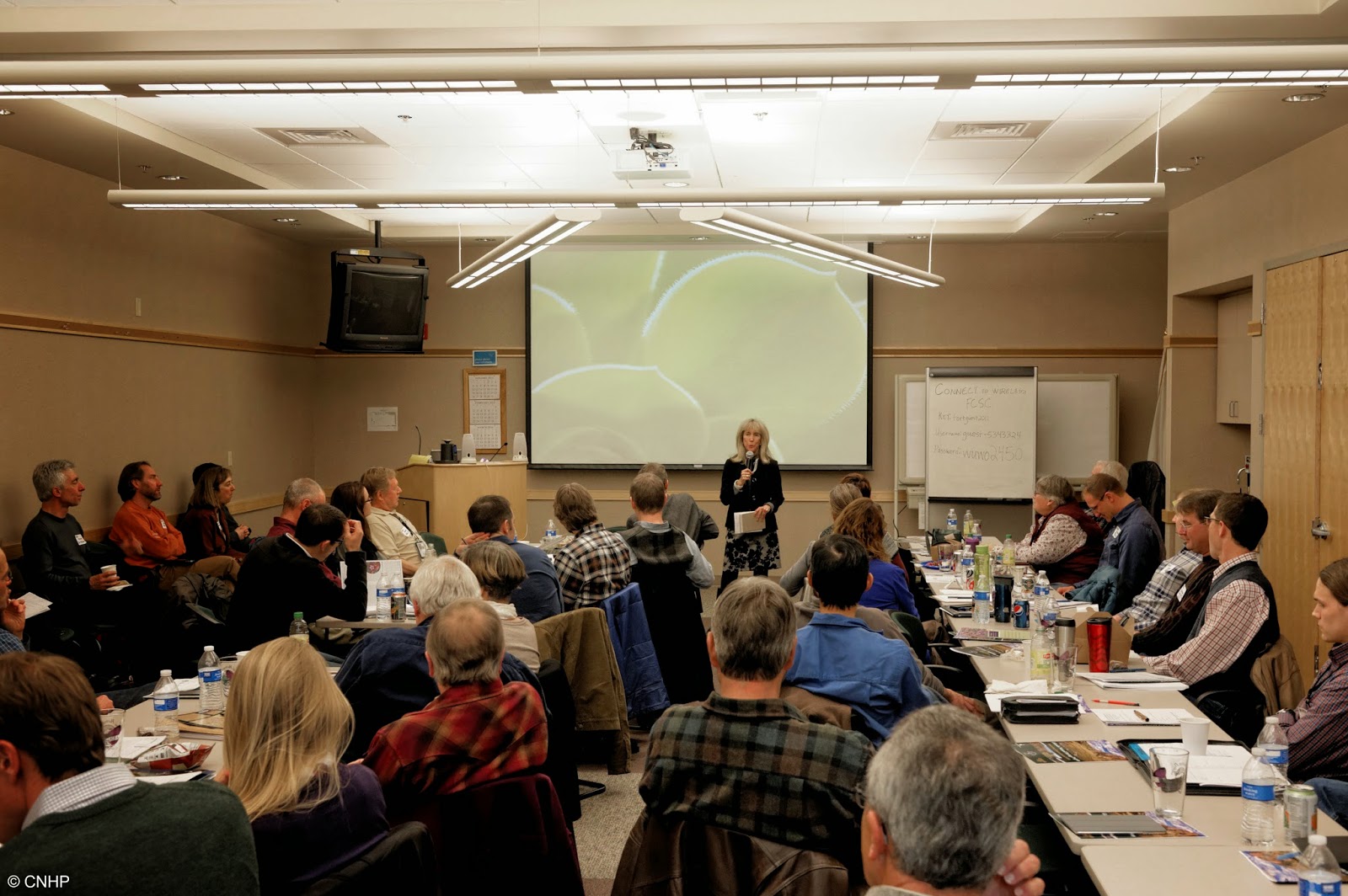
Dean of the Warner College of Natural Resources Joyce Berry welcomes the Partners

I’ve gotten some nice feedback from several folks who came.  Tim Hogan, Collections Manager at the University of Colorado Museum of Natural History Herbarium, said “Just want to compliment you and all your comrades for putting on a very good show yesterday.  I do appreciate how much work is involved in pulling something like that together.  It was an interesting group of people, and it was a treat for me to see some folks I haven’t seen in too long a time and meet others whom I’ve never met face-to-face.”  Joyce Berry, Dean of the Warner College of Natural Resources, said “I really am so proud of all that you are doing.  Having all your partners show up like that is also another indicator of CNHP’s success.”

Chris Pague, TNC Senior Conservation Scientist,
sharing thoughts about working with CNHP

We have set up a new webpage where we’ve posted a recording with powerpoint presentations, notes, and photos from the event.  You can also see all of Michael Menefee’s photos from the Partners Meeting on our Facebook page.

Bruce Rittenhouse, BLM Natural Resources Branch Chief,
talks about BLM’s landscape-level approach to conservation through the REAs.

We are interested in continuing this, perhaps annually, and we are interested in feedback about the meeting and how we could do it better in the future.  We have posted a short survey where you can offer us comments and suggestions about this.

Thank you from all of us at CNHP to everyone who came and made this great day possible.  It was a huge thrill to spend the day with you and envision an exciting future together!