
- working with the Conservation Planning team and other Colorado Natural Heritage Program (CNHP) staff to identify and secure sources of funds, projects, and collaborative opportunities and participate in proposal development
- incorporating best available science and biodiversity information into conservation action plans, partnership initiatives, and other planning and implementation efforts
- working closely with CNHP staff to support programmatic data, communication, planning, and partnership building goals associated with the strategic plan
- developing and revising project workflow timelines, managing budgets, collaborating with other project staff to ensure timely delivery of quality products.
Wednesday, May 11, 2016
Job Announcement: Conservation Planning Coordinator
The Colorado Natural Heritage Program (CNHP) of Colorado State University is seeking a Conservation Planning Coordinator. The Coordinator will be part of a team that currently includes a Conservation Planner, a Conservation Ecologist, a GIS analyst/Landscape Ecologist, and the Team Leader/Ecologist. The Coordinator will work on existing Conservation Planning projects in addition to writing proposals for new or on-going work. Key duties and responsibilities include:


Monday, April 18, 2016
CNHP Helps CSU Students Build Field Sampling Skills
Last week CNHP staff members, along with CSU professors Tara Teel and Terra Sampson, spent a day in the field with graduate students from the Conservation Leadership Through Learning Program (CLTL). The CLTL is an innovative graduate program that teaches students how to confront conservation challenges and sustainability from a variety of perspectives. This year’s student cohorts are wrapping up their second semester at CSU, and will spend the last two semesters of their graduate work in places like Kenya, Peru and Namibia.
CNHP staff members Pam Smith, Jeremy Siemers and Susan Panjabi, along with Director Dave Anderson and Crystal Strouse from the City of Fort Collins Natural Areas Department, taught CLTL students basic field survey methods and resource management skills at Coyote Ridge Natural Areas in Fort Collins. The students learned about resource management challenges and successes from Crystal Strouse, City of Fort Collins Natural Areas Department Botanist. CNHP staff discussed issues with prairie dog management and rare plant management in public parks. The students got hands on training collecting qualitative and quantitative field data using different kinds of sampling plots and photo monitoring points. The CLTL students can use these field skills to design similar studies as they head out to their study sites across the world.
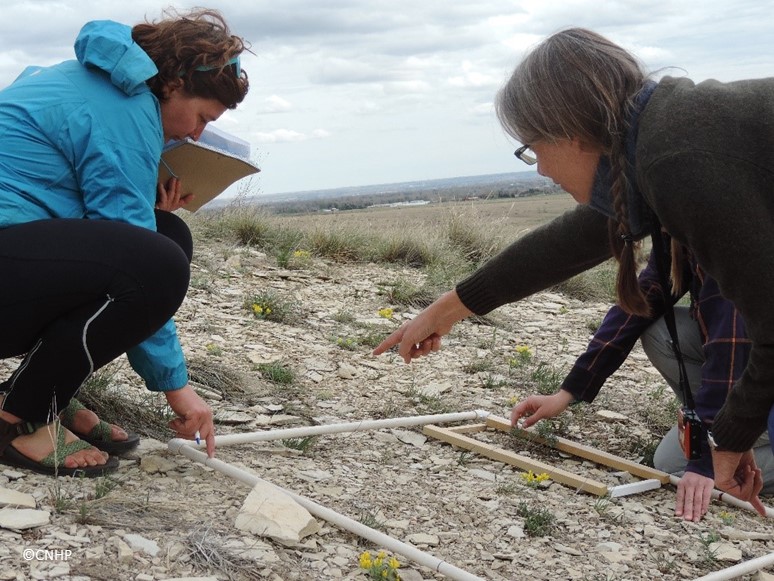 |
| Pam Smith, CNHP Botanist (right), shows a CLTL student (left) how to identify the rare plant Bell's twinpod (Physaria bellii). |
 |
| CLTL graduate students learn to sample vegetation plots at Coyote Ridge Natural Area, Fort Collins. |
 |
| CLTL students preparing to go out in the field at Coyote Ridge Natural Area after an introduction from Crystal Strouse (left), City of Fort Collins. |
Tuesday, April 5, 2016
Colorado Wetlands App Now Available for Android and iPhones
Just in time for field season, the Colorado Natural Heritage Program is pleased to announce the release of the Colorado Wetlands Mobile App! The App is available for FREE at both the Google Play Store and iTunes App Store.
The Colorado Wetland Mobile App contains three main sections:
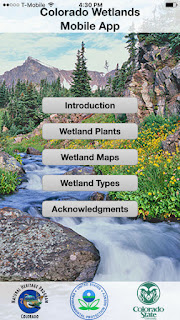 Wetland Plants: Detailed descriptions and photos of 711 plant species found in Colorado’s wetland and riparian areas. The plants are searchable through many different search criteria and filters.
Wetland Maps: Access to digital National Wetland Inventory (NWI) maps. The App shows NWI maps for the entire state of Colorado and can use location information from the device to show mapped wetland where the user is located. The Maps screen can also be used to search for wetland plants potentially found at the user’s location.
Wetland Types: Brief description of the most common wetland and riparian types found in Colorado.
Wetland types can also be used as a filter for searching plant species.
For more information, see the user's manual online.
CNHP welcomes your feedback! Comments and questions can be addressed to Denise Culver or Joanna Lemly.
The Colorado Wetland Mobile App contains three main sections:

Wetland Maps: Access to digital National Wetland Inventory (NWI) maps. The App shows NWI maps for the entire state of Colorado and can use location information from the device to show mapped wetland where the user is located. The Maps screen can also be used to search for wetland plants potentially found at the user’s location.
Wetland Types: Brief description of the most common wetland and riparian types found in Colorado.
Wetland types can also be used as a filter for searching plant species.
For more information, see the user's manual online.
CNHP welcomes your feedback! Comments and questions can be addressed to Denise Culver or Joanna Lemly.
Monday, February 29, 2016
CNHP Staff Mentor Future Conservation Biologists
CNHP continues to take a lead role in developing the future conservation biologists in Colorado. Annually, CNHP mentors honors undergraduate students as they tackle research on rare species of Colorado. The most-recent graduate is Rachel Maison. Rachel is an honors student in the Fish, Wildlife and Conservation Biology Department. She conducted independent research on the occupancy and habitat associations of the hops blue butterfly (Celastrina humulus). She continued the research begun by Callie Puntenney in 2014, which was recently accepted as a publication in the Journal of Insect Conservation. Rachel’s research discovered that hops blue butterflies are prevalent on the U.S. Air Force Academy where there are large expanses of wild hops (Humulus lupulus). Wild hops is the host plant of the hops blue butterfly. Additionally, she found that hops blue butterflies are prevalent in areas where ant nests are abundant. Because many of the members of the blue butterfly family (Family: Lycaenidae) have larva that are tended by ants, Rachel incorporated ant-nest searches into her research project.
 |
| CNHP zoologist Rob Schorr (left) served as a mentor to CSU student Rachel Maison (right), helping her design and complete an independent research project on occupancy and habitat associations of hops blue butterfly (Celastrina humulus). |
Wednesday, February 17, 2016
CNHP Internship Positions Available for Summer 2016
CNHP is looking for six Colorado State University students interested in expanding their knowledge and experience in conservation science. Interns will build skills in plant identification, vegetation sampling, animal monitoring and surveys, monitoring protocols, data collection, and describing conservation values. Interns will be paid $12/hr, with per diem provided for overnight field trips. Program begins May 23, 2016 and ends August 5, 2016. Applications are due by March 31, 2016. For more information read the full announcement on our website.


Tuesday, January 26, 2016
Job Announcement: Database and Web Developer
The Colorado Natural Heritage Program (CNHP) of Colorado State University seeks up to two Database and Web Developers to design and support natural resource-based databases for CNHP clients, assist in the administration and maintenance of existing online databases, and work closely with others at CNHP to develop data products and improve data services. The position(s) will play a pivotal role in expanding CNHP’s data delivery tools through emerging technologies like web-based mapping and data delivery systems, and mobile applications. These are full-time positions. The incumbent(s) will have the opportunity to collaborate with CNHP staff and partners to develop proposals for grants and projects to ensure continued funding of their position(s).
The incumbent(s) must be able to work independently and with the team. A commitment to conservation and familiarity with environmental datasets is necessary to thrive at this position. CNHP provides a flexible work environment and excellent benefits.
To apply and view a complete position description, please visit: https://jobs.colostate.edu/postings/30429
Applications deadline is February 15, 2016.

Reflecting departmental and institutional values, candidates are expected to have the ability to advance the Department's commitment to diversity and inclusion.
CSU is an EO/EA/AA employer and conducts background checks on all final candidates.
The incumbent(s) must be able to work independently and with the team. A commitment to conservation and familiarity with environmental datasets is necessary to thrive at this position. CNHP provides a flexible work environment and excellent benefits.
To apply and view a complete position description, please visit: https://jobs.colostate.edu/postings/30429
Applications deadline is February 15, 2016.

CSU is an EO/EA/AA employer and conducts background checks on all final candidates.
Sunday, January 17, 2016

Thursday, November 19, 2015
Last fall, CNHP’s Rob Schorr and Bernadette Kuhn, and WCNR’s Human Dimension in Natural Resources specialist Shawn Davis, began a collaborative project with bat biologists, rock climbers, and natural resource managers. The project, called Climbers for Bat Conservation (CBC) successfully pulled all parties together to discuss the use of climbers as an information resource for where bats might be roosting in rock crevices. The CBC project recently had a warm reception at the North American Society for Bat Research 45th Annual Symposium hosted in Monterey, California. Rob Schorr was able to present a poster discussing the development of the collaboration, the challenges and opportunities the collaboration presented, and the hope for future progress. Many bat biologists appreciated the citizen science focus and liked the diligence taken to make sure this was a climber-supported endeavor.
 |
| Rob Schorr presents his poster on the Climbers for Bat Project. |
 |
| The Climbers for Bat Conservation poster at the 45th Symposium of the North American Society for Bat Research. |
Subscribe to:
Posts (Atom)

