Tuesday, July 26, 2011

Extreme Botany

CNHP botanist Bernadette Kuhn recently reported on her summer field work. If you think botany is boring, think again!

BLACK CANYON GILIA: CLIFF HANGER

The Black Canyon of the Gunnison National Park is home to the cliff-dwelling Black Canyon gilia (Gilia penstemenoides). Working with the National Park Service, we recently conducted surveys for Black Canyon gilia in the Park and the Curecanti National Recreation Area. In order to reach the plants, we roped up and rapped down onto the cliffs that tower nearly 2,000 feet above the Gunnison River.

 Mike Schneiter rappels off of the South Rim of the Black Canyon in search of Gilia penstemenoides. Twenty plants were found on the cliff faces directly below him.

 Bernadette Kuhn scanning the small crevices for the elusive Black Canyon Gilia.

Black Canyon gilia is a Colorado endemic that grows in small cracks on vertical rock faces.  A spotting scope and climbing gear proved necessary for spotting Black Canyon gilia.  We documented new occurrences on the North Rim, and relocated many old occurrences of this cliff-dwelling plant.  

Cheatgrass towering over a tiny gilia  
 
We were excited to locate so many individuals, even though the plants were not yet flowering.

 The Gunnison River, at peak flow for 2011, snaking through the Black Canyon of the Gunnison National Park.

After a week of field surveys, we concluded that Black Canyon gilia has a broader range in the Black Canyon than previously documented. However, most of the cliff faces we accessed with climbing gear contained fewer than 30 individuals.  More surveys are needed to fully document the extent of the plant in the canyon.  Furthermore, there have been no life history, demography, or longevity studies conducted for Black canyon gilia, so much work remains to be done before we will know the full story of this little plant. 

Special thanks to NPS ecologist Danguole Bockus for partnering with CNHP on this project.


Thursday, July 14, 2011

Rare plant and habitat photos needed

As part of a broader project to update the on-line Colorado Rare Plant Field Guide, we are looking for photographs of a number of rare species and their associated habitats. Close up photos showing the flowers and/or fruit, full plants, and habitat would be ideal. As we continue develop the on-line guide we will be seeking additional photos of other species as well.

  • Boechera glareosa- Moffat County, flowers in May-June, could target for fruit this year.
  • Delphiunium robustum- Robust larkspur- Saguache, Huerfano, Las Animas, and El Paso counties, flowers in July-Sept.
  • Draba rectifructa- Mountain draba-Grand, Summit, Rio Blanco, Gunnison, Ouray, Mineral, and Teller counties, flowers in June (photograph fruit this year)
  • Lepidium crenatum- Alkali pepperweed-Moffat, Rio Blanco, Mesa, Delta, Montrose, Montezuma counties, flowers in May –Sept.
  • Physaria alpina- Avery Peak twinpod-Gunnison, Pitkin, Lake, and Park counties, flowers July-August
  • Puccinellia parishii- bog alkaligrass-San Miguel, Dolores counties, flowers in June

If you have photos you would like to submit, or would like more information, please contact CNHP Senior Botanist Susan Spackman Panjabi. (Link takes you to our contacts page, scroll down to find Susan.)

Tuesday, July 12, 2011

Rock-loving Aletes habitat, fourteen years later

On July 1, 1997, CNHP staffers Renée Rondeau and Phyllis Pineda went in search of the rock-loving Aletes (Aletes lithophila), a fragrant herbaceous perennial in the carrot family that is endemic to Colorado. Their hunt was successful, finding thousands of plants tucked into the shallow and rocky volcanic soils on ridges and north-facing slopes within the San Luis Valley. GPS devices were large and expensive in 1997, so everything was done with a compass and a paper topo map. Plants were counted, a polygon was drawn on the map, and several photos were taken (with slide film! remember film?). The resulting documentation of the location of the photos were penciled dots on the map labeled "photo."

Aletes lithophila happily growing in 1997.

Flash-forward 14 years. On July 4, 2011, in preparation for an upcoming field trip, Renée searched through her 1997 files and found her old slides, topo map, and field notes. She laboriously spent the 4th of July coaxing our old slide scanner into reading the slides to produce digital files that could be printed, finishing up just in time to take in Fort Collins community fireworks!

The next morning, Renée and Mindy Gottsegen (from State Land Board) headed to the Biedell Stewardship Trust parcel to look for the rock-loving Aletes. First stop was to revisit the 1997 site (on National Forest land) to get a good search image of the plant and to make sure the plant was managing to survive during the extreme drought that the San Luis Valley is currently experiencing. Estimated coordinates were entered into the hand-held GPS, and the printed photos were held aloft to compare with the modern scenery.

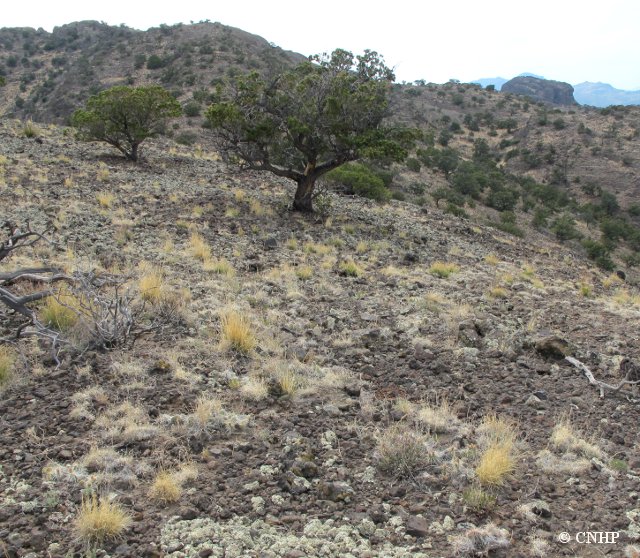
As Renée tells it: "As we approached our location everything started coming into focus and we started finding Aletes and seeing the striking views of volcanic cliffs and domes that were prevalent in the 1997 photo. When we saw the same dead pinyon pine from the photo, we knew we had relocated this non-descript location. The day was wearing on, so we weren't able to fine tune our exact location before snapping a few photos, but in spite of this we did get close enough to document the change, or really lack of change, since 1997. The original photo, judging by the shadows, was taken on a clear morning and our 2011 photo was taken on a hazy afternoon, due to nearby fires. In spite of the less than precise match we can still say something about the persistence of live and dead plants."

Reviewing the foreground, in front of the pinyon pines (both dead and alive), of the photos below, we can see that, in the relatively wet year of 1997, Aletes (the little green clumps) were common. In contrast, 2011 has been very dry in the Valley, reducing the cover and density of forbs, including Aletes. Drought tolerant grasses (all native) are a lot more noticeable in 2011 than in 1997. The live pinyon trees also haven't changed much in fourteen years.

1997 - view from the dead pinyon

2011 - still dead!
1997 - live pinyons

2011 - there they are to this day.

The low moisture environment of the San Juan foothills is a place where plants grow slowly and decomposition is even slower. Aletes is surviving the drought but fruit production was hardly evident in 2011.


Aletes lithophila hanging on in the 21st century.

Now that we know the precise location of the 1997 photo, perhaps
Renée can go back in a wetter year and hopefully see a vibrant Aletes population once again. Renée and Mindy went on from this spot to survey the State Land Board lands and located three new populations of Aletes lithophila.

CNHP has a plethora of old slides that should be scanned in while we still have the technology. If you would like to volunteer with CNHP to help us archive our old and aging slides, please contact Renée.

Friday, July 8, 2011

Adopt-a-rare-plant success


Earlier this year, a cooperative effort between the Colorado Native Plant Society, Denver Botanic Gardens and the Colorado Natural Heritage Program re-launched the Adopt-a-Rare-Plant program. This volunteer effort is aimed at revisiting “historical” locations of Colorado rare plants that have not been observed for 20 years or more. More than 30 people took part in training in March, and now reports are beginning to come in from their efforts. Ann Henson and Karen Hunter recently sent us some photos from their search for the Cathedral Bluffs meadow rue (Thalictrum heliophilum).


Two views of Cathedral Bluffs- what a panorama!


A couple of portraits of the adopted plant - you'd probably look a little scraggly too if you lived here.

 Yikes! It is a bit steep - time for botany by binocular?

Ann recording data.

 Karen searching - now where was that plant?

 The intrepid searchers back at camp, with a little light reading 
(Colorado Flora: Western Slope). 
Yes, I think I can see the plant from here.

Well done Ann and Karen!