Tuesday, February 12, 2013
Wanted: Wetland Ecology Field Technicians for Summer 2013 work!
The Colorado Natural Heritage Program (CNHP) at Colorado State University (CSU) seeks 4–6 experienced field technicians for summer field work assessing the condition of wetlands throughout the lower South Platte River Basin. All positions require field botany or ecology skills. Knowledge of plant taxonomy and species identification required. Preferred qualifications include experience in wetland or riparian ecology, knowledge of local flora, and familiarity performing field work for long days (10+ hours).
Fieldwork will take place in randomly selected wetlands in urban areas, agricultural areas, and more remote natural areas as part of wetland condition and wildlife habitat assessment. Standard duties will involve driving and hiking to field sites; in-field plant identification and in-office plant identification with a microscope; extensive collection of vegetation, soil, wildlife habitat, and environmental data; detailed completion of field survey forms; and landowner interactions.
For more details and to find out how to apply, read the full announcement here!
Thursday, February 7, 2013
New Report: Treeline Monitoring in the San Juan Basin Tundra
Mountain ecosystems, particularly alpine, are among the most vulnerable to climate change. Warming conditions are likely to cause trees and shrubs to encroach into alpine tundra habitats, which are home to many species found nowhere else.
CHNP, in cooperation with the Bureau of Land Management, U.S. Forest Service and Colorado College, began a pilot project to monitor treeline expansion in the San Juan mountains. A combination of fieldwork and spatial analysis was used to determine if the treeline on the southwest slope of Kendall Mountain had changed in the last 50 years.
Aerial imagery from 1951 and 2011 were used to establish transects perpendicular to the treeline to detect growth of new trees upslope, which would indicate an upward advancement of trees into alpine areas. The location of trees along these transects were then field verified, and a subset of trees were cored to determine their age. Additionally, the density of trees below the treeline was calculated for both time periods.
![]() |
| Recruitment above treeline |
For more information, see the complete report. We hope to expand this pilot project to study more treelines throughout the San Juan mountains, to determine if these increases in growth rate and tree density are consistent trends that can be correlated with measured increases in average summer temperatures.
Wednesday, January 30, 2013
Reference Wetlands and Disturbance in the Lower South Platte River Basin
By Laurie Gilligan, CNHP Wetland Ecologist
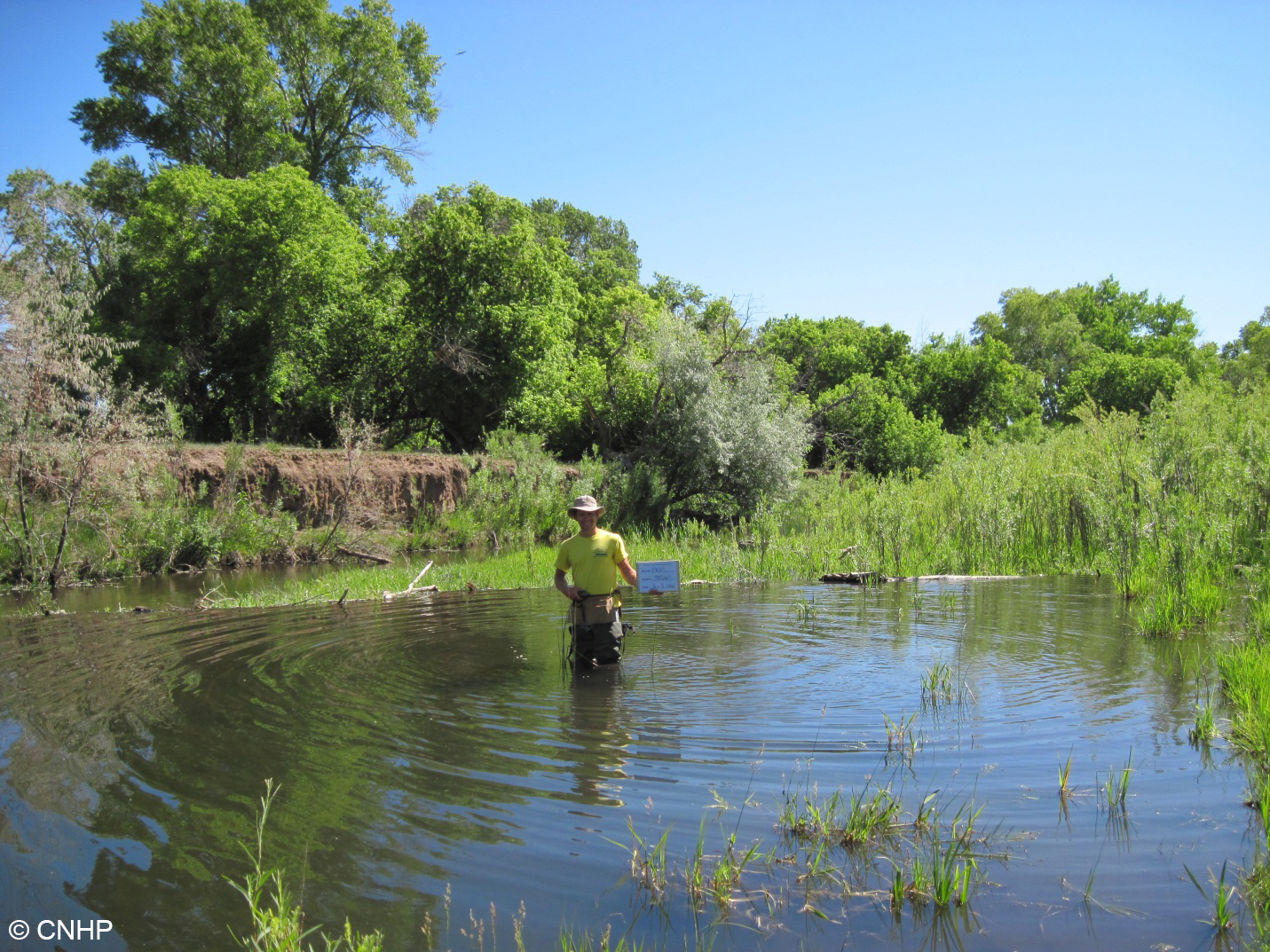
Last summer, CNHP’s Erick Carlson and I were a two-person team of wetland ecology buffs who spent some plant lD-filled, glorious hours sampling wetlands and riparian areas in our home river basin - the Lower South Platte River Basin. The ‘Lower’ portion of the South Platte refers to the non-mountainous section of the basin, so we surveyed many wetlands and riparian areas in northeast Colorado’s Great Plains.
We sampled two kinds of sites:
- reference examples (or the best we could find) of wetlands and riparian areas as mapped by the 1970’s National Wetlands Inventory (mapping digitized right here at CNHP by Gabrielle Smith and Erick); and
- reference examples of wetlands managed by Colorado Parks and Wildlife and other partners for wildlife habitat diversity and waterfowl use.
Although no sites selected for reference sampling were located in our home city of Fort Collins, we think the random sample of wetlands scheduled for next summer’s portion of this study just may include a few in our backyard.
So what kinds of wetlands were the best of the plains? Well, quite a variety! So enjoy the pictures, and if you like what you see, in the next couple of weeks keep your eyes peeled for our Summer 2013 wetland field technician job search posting on our website!
Though it has been ~40 years since the wetlands of the Lower South Platte basin were mapped, this project is the first of its kind to sample and understand the full range of wetland and riparian diversity across the basin. After a successful summer of surveying 35 reference sites, disturbance ecology proved to be the summer’s mantra. This made for an interesting field season. While landscapes that are less disturbed from anthropogenic effects are the most sought-after for reference sampling, it was a regime of natural disturbance (flooding, beaver activity, wet and dry cycles, etc.) that tied together many of these sites and made them the local gems that they are. Disturbance can be natural, and nature is variable…
Monday, January 28, 2013
A Trip to Washington DC
by David G. Anderson
A visit to Washington DC is always interesting and inspiring, and my trip this month was no exception! There were several reasons to go this time. I gave two presentations on CNHP’s projects at the Transportation Research Board’s (TRB) annual Meeting. One was on our wildlife escape ramp study, led by Jeremy Siemers, and funded by CDOT. The other was on our pilot test of the Integrated Ecological Framework, a project funded by TRB.
This conference
coincided with the Disasters and Environment Conference, held by the National Council for Science and the Environment. CSU is
a sponsoring institution of this conference and our Dean, Joyce Berry, and our
Provost Rick Miranda were there. There were presentations by many inspiring
environmental leaders (the outgoing director of NOAA, Jane Lubchenco, gave a memorable presentation).
![]() |
| The beautiful Ronald Reagan Building, where the Disasters and Environment conference was held. |
And of
course, I also spent a day visiting our friends at NatureServe’s headquarters
in Arlington, Virginia. With Leslie
Honey, Vice President of Conservation Services for NatureServe, I met with Dan
Fenn, a staffer in Senator Mark Udall’s Office.
We showed him the State of Colorado’s Biodiversity 2011 and gave him a
copy of CNHP’s High Park Fire poster, and it was a wonderful
opportunity to highlight some of the ways that we can help identify no-regrets
conservation solutions. Leslie and I
made a great team and I hope we can visit our congressional representatives
again before long! It was fun to visit
our friends at NatureServe- thank you to everyone (Pat, Leslie, Lori, Don,
Rob, Kat, and Bruce) for your hospitality.
Two of our
friends from Oregon, Jimmy Kagan (Director of the Oregon Biodiversity
Information Center (ORBIC), CNHP’s analog in that state) and Lisa Gaines
(Director of the Oregon Institute for Natural Resources), spent the week there
as well and we did a pretty good job of trying some of Washington’s fabulous
culinary offerings together while figuring out how to conserve the world's biodiversity. Jimmy and I visited the wonderful United
States Botanic Garden between meetings on the last day of my stay. One of my favorite things there, aside from
the beautiful orchid collection, was getting to see the Wollemi pine. I had read about the discovery of this
ancient tree species in the Blue Mountains of Australia 10 years ago, and it
was wonderful to meet this species in person!
![]() |
Jimmy Kagan,
Director of the ORBIC - a rare species indeed.
|
![]() |
| Wollemi Pines in the Rare and Endangered Species Collection at the US Botanic Garden |
On the last
evening of my stay I walked down Pennsylvania Avenue back to my hotel (after
stopping for a beer near the Whitehouse, where I met the City Manager of the
City of Auburn, WA and a former hedge fund manager for Louis Bacon - both classic
Washington DC experiences), and followed the parade route for Obama’s
Inauguration.
![]() |
Pennsylvania
Avenue on January 17th, just before Obama’s Inauguration
|
It was
wonderful to showcase CNHP’s success, leadership, and conservation innovations
in Washington DC with our national leaders.
I am so proud to work at a Heritage Program that has so much to offer in
this regard!
Tuesday, January 22, 2013
CNHP Completes Data Exchange with NatureServe
CNHP
is a member program of NatureServe. NatureServe has 82 member programs in Canada, the United
States, Latin America, and the Caribbean. The power of the network lies in its consistent
use of heritage methodology. Local data are collected and ranked in similar
fashion by member programs, and as such, are scalable at national and
international levels. Data exchanges between NatureServe and member programs ensure
that the entire network has up-to-date information on species’ global
imperilment ranks and conservation priorities.
![]() |
| Earth from space |
In September 2012, CNHP exported and delivered data on
Colorado’s rare and imperiled species to the NatureServe office in Arlington,
VA. By December 2012, CNHP received the data back from NatureServe, complete
with the latest international ranks and taxonomic information, and integrated
the changes into Colorado’s BIOTICs database. This is likely our last data
exchange. NatureServe is developing an online database which will replace the
current data exchange process and provide real-time data synchronization in the
future!
![]() |
Map of Natural Heritage Member Programs
|
Thursday, January 10, 2013
New CNHP employee: Jeremy Sueltenfuss
After receiving a bachelor’s degree from Colorado College, my wife and I moved to Venezuela for two years, where we both taught at an international private school. Teaching middle and high school science was a great way to pass on my passion for the natural world to young eager minds. After teaching for two years, we moved back to Colorado for me to complete a Master’s degree from Colorado State University.
![]() |
| Jeremy Sueltenfuss and his dog Elvis |
Though most of my undergraduate research
focused on the response of various wildlife communities to forest management,
my interest in wetlands brought me to CSU to look at the impacts of irrigation
in the west on wetland ecosystems. Agricultural diversions have severely
degraded the majority of western rivers, but leaky earthen canals transporting
this water over large distances create a substantial amount of wetland area
across our otherwise arid landscape. After graduating in the summer of
2012 I worked on a wetland restoration project for the National Park
Service. Historic land use at Florissant Fossil Beds had
channelized a wet meadow in the area. We filled each of the channels and
restored the natural hydrologic regime within the valley. After this
great experience CNHP hired me as a wetland ecologist and GIS specialist and I couldn't be
happier!
Friday, January 4, 2013
The State of Colorado’s Biodiversity
For the first time in Colorado, scientists and land managers have access to a comprehensive report that measures conservation progress during the past 40+ years. The Nature Conservancy and the Colorado Natural Heritage Program at Colorado State University recently released a report on the state State of Colorado’s biodiversity which ranks the state’s natural heritage as “in relatively good condition” or “restorable.” The report identifies progress on many plant and animal species but notes that significant challenges remain.
- Colorado’s major habitat types are all important for at-risk species and are relatively intact with at least 70% scoring good or very good based on size, condition, and the surrounding conditions.
- About 40% of all fish and amphibians are inadequately conserved, an indicator of the condition of Colorado’s streams, rivers, and wetlands.
- Colorado’s prairies are the most highly altered and least protected natural systems and support the most at-risk animals.
- Many of Colorado's rarest plants are effectively conserved; others are at risk in the path of energy and urban development
- Lower elevation forests (especially pinyon-juniper and ponderosa pine) are in the poorest condition, are significantly under-conserved and present a high risk of severe fire.
Early reviews from our partners have been favorable:
--Tom Gougeon
President, Gates Family Foundation
--Tammy VerCauteren
Executive Director, Rocky Mountain Bird Observatory.
Wednesday, January 2, 2013
NEW GEOSPATIAL DATASET ONLINE: Terrestrial Ecological System Patches
Terrestrial Ecological Systems are dynamic groupings of
plant and/or animal communities that: 1) occur together on the landscape; and
2) are linked by similar ecological processes, underlying abiotic environmental
factors, or gradients; and 3) form a readily identifiable unit on the ground
(Comer et al. 2003). In order to assess the health of Colorado’s major
ecosystems, CNHP developed a dataset of large-sized (>20,000 acres) ecological
system patches for the “State of Colorado’s Biodiversity” project.
Ecological systems were derived from the Southwest Regional Gap Analysis
Project landcover dataset (USGS 2004).
Developing this dataset enabled CNHP to identify at-risk
ecosystems in Colorado. Individual patches were ranked on a scale of 1-10 based
on overall condition status, threat status and protection status. Top threats
were assigned to each patch. The results of the analysis show that many of
Colorado’s major ecosystems are intact, but only two are effectively conserved.
Shortgrass prairie is by far the most altered ecological system. Nearly half of
the shortgrass prairie in Colorado has been lost in the past century; however,
several large, high quality areas still exist. While these data are an
effective tool for broadly measuring current successes, they also highlight
intact landscapes that pose great opportunities for future conservation
efforts.
| Table with Conservation Status Ranks of Major Ecological Systems in Colorado |
These
data are bundled in an ESRI geodatabase and can be downloaded from CNHP’s
website here. As
always, if you need more detailed information or need data for commercial use,
please contact our Data Distribution Coordinator.
Subscribe to:
Posts (Atom)