Friday, March 9, 2012

Colorado Wetland Mapping - Then and Now

by Gabrielle Smith, CNHP Wetland Mapping and GIS Specialist

In the 1970’s the US Fish and Wildlife Service started a wetland mapping program called the National Wetlands Inventory (NWI) , with the goal of mapping the entire country’s wetland resource. Using the Cowardin system of classification, most of the country was mapped from approximately 1975 to 1985 by people looking at aerial photos through stereoscopes and drawing the wetland outlines with markers on sheets of transparent plastic. This original mapping was at resolutions ranging from 1:24,000 to 1:50,000. Over the course of the following decades, individual states have scanned these data into image files that can be viewed on a computer screen, and many have produced updated data building upon the same basic methodology. However, only recently has true digital wetland mapping really taken off.

CNHP first began working on statewide wetland data in 2008, in partnership with Colorado Parks and Wildlife (CPW). At that time, there was very little digital mapping available:


All of the data represented by blue in the above map were scanned images – useful for site-specific exploration, but not usable for analysis. CNHP and CPW have worked with a variety of partners (U.S. Environmental Protection Agency, U.S. Forest Service, Bureau of Land Management, local governments, and others) to digitize and update the 1970’s era scans and increase Colorado’s capacity to make informed decisions regarding wetlands. Now, due largely to CNHP and CPW's efforts, the statewide wetland mapping status map for 2012 looks like this:

Making informed decisions about Colorado’s wetlands has critical implications for Colorado’s biodiversity: while it is estimated that only about 2% of the land area of Colorado is wetland, that 2% of the state supports over 40 vertebrate species of concern:

Species of concern in relation to habitat prevalence.

Modern Geographic Information Systems (GIS) allow wetland mappers to improve upon the original NWI data. By using a variety of data sources and improved resolution National Agriculture Imagery Program (NAIP) true color and infrared aerial photos, wetland mappers can delineate wetlands at much finer resolutions and higher ground-verifiable accuracy. Wetlands mapped to the 2009 time period are typically mapped at 1:3,000 to 1:10,000 resolutions.

The following images show infrared / true color examples of some Colorado wetlands in Park County.

Beaver Pond Complex at high altitudes, with ponds surrounded by saturated shrubs.
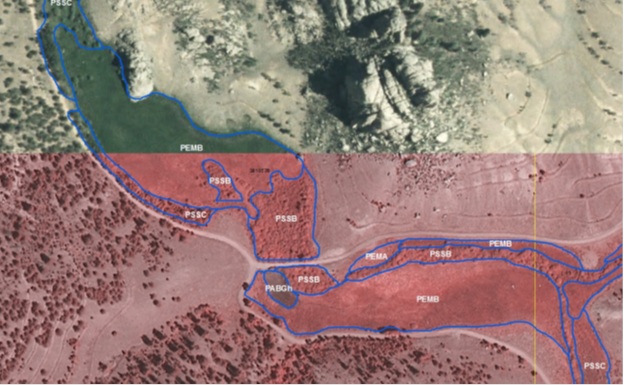
Two fens: PEMB stands for Palustrine Emergent Saturated wetland.

Alkaline playas: these wetlands are ephemeral and may go several years without a flood event. PUSCh stands for Palustrine Unconsolidated Shore Seasonally Flooded Impounded.

Monday, March 5, 2012

New report: Climate change vulnerability assessment of the Gunnison Basin

A new report is available on our Documents and Reports page. The Gunnison Basin climate change vulnerability assessment report was a joint effort between the Colorado Natural Heritage Program, The Nature Conservancy, the University of Colorado, Boulder, and the University of Alaska, Fairbanks. The project was done for the Gunnison Climate Working Group, a partnership of public and private organizations working to build the resilience of species and ecosystems so that they continue to provide benefits to people of the Gunnison Basin.

The project identified which species and ecosystems of the Gunnison Basin, Colorado, are likely to be most at risk to projected climatic changes and why they are likely to be vulnerable. The report is intended to help natural resource managers set priorities for conservation, develop effective adaptation strategies, and build resilience in the face of climate change.

Wednesday, February 29, 2012

The Wildlife Society Chapter Service Award

Earlier this month, Rob Schorr, CNHP Zoologist, was awarded the Colorado Chapter of The Wildlife Society's (CCTWS) Chapter Service Award during the 2012 CCTWS Annual Meeting in Grand Junction, Colorado. This is an annual award given to one member who displays exceptional initiative in service to the chapter.

Rob earned the award for serving on the CCTWS Board for 7 years, fulfilling the positions as President, President-elect, Past-President, Secretary, Northeast Representative, and At-Large Member (whew!). Also, Rob was instrumental in developing the CCTWS Travel Grant award, which provides funds for travel to professional meetings and training, and the CCTWS Certification Facilitation Program, which helps members become Certified Wildlife Biologists.

Rob Schorr (right) receives the Chapter Service Award from Bob Davies of Colorado Parks and Wildlife. Picture courtesy of CCTWS.

Congratulations Rob!

Wednesday, February 22, 2012

Botany A to Z: Draba

By Karin Decker

is for Draba

Drabas belong to the Mustard family (Brassicaceae), and in fact, Draba is the largest genus in the family, both worldwide and in North America.  There are currently 121 recognized Draba species in the Flora of North America, with the greatest concentration of species in the western United States. Most species of Draba are found at high elevations or high latitudes, and endemism in local mountain ranges is frequent in the genus.
 
High elevation habitat beloved by Draba crassa and D. streptobrachia.

 
 Draba graminea in tough habitat - small but durable!
 
The original Greek name was applied to a type of cress. The common name of whitlow-grass apparently got attached to Draba verna because it was a plant believed to cure whitlows (look it up - eew!).

Are Drabas drab? Not when they are flowering - look at Draba borealis!

Oh, well, Draba fladnazensis is a little shy and retiring.

As a genus, Draba hasn't really settled on a single reproductive method – different species may reproduce via apomixis (various forms of asexual reproduction), autogamy (self-pollination), or outcrossing (exchanging pollen with other individuals). All of this can make taxonomic classification of the various species difficult to work out, since the plants don’t easily fit into the biological species concept, where the units of classification are interbreeding populations.
 
There are more than 2 dozen species of Draba reported from Colorado, and seven of them are endemic to the state. CNHP tracks 16 species:
 
 
Documented locations of rare Draba species in Colorado. Endemic species are colored and labeled, non-endemic are gray.

Thursday, February 9, 2012

Job Opening: Wetland Ecology Field Technicians

We have seasonal job openings for 4 to 6 Wetland Ecology Field Technicians to work throughout the lower South Platte River Basin this summer.

All positions require field botany or ecology skills. Knowledge of plant taxonomy and species identification is required, and experience in wetland or riparian ecology, knowledge of local flora, and field work experience involving camping and backpacking is desired. Standard duties will involve driving and hiking to field sites, in-field plant identification and in-office plant identification with a microscope, detailed completion of field survey forms, and interaction with landowners.


First consideration of applicants will begin February 19, 2012. Applications will continue to be accepted until all positions are filled. For more information on the position and how to apply, see the full announcement on our Employment and Volunteering page.

Tuesday, February 7, 2012

2011 Adopt-a-Rare-Plant Awards

The 2011 Adopt-a-Rare-Plant session wrapped up last month at the Denver Botanic Gardens. Accomplishments of the program in 2011 include:
  • Trained over 30 volunteers
  • Visited more than 25 sites
  • Relocated 15 occurrences that were previously ranked "historical"
  • Volunteers contributed 275+ hours to the program
Three volunteers were recognized for their efforts:

Ann Henson - Joint award (Adopt-a-Rare-Plant and Rare Plant Monitoring Stewards
Ann adopted the Cathedral Bluffs meadow rue (Thalictrum heliophilum). She visited and updated two occurrences in the Cathedral Bluffs area, and collected seed for the Center for Plant Conservation. Ann was also instrumental in revitalizing the program for the benefit of Colorado Native Plant Society members, spending 50 hours on program activities.

Brad Klafehn  
Brad adopted Rothrock's Townsend daisy (Townsendia rothrockii) and visited all three of his adopted occurrences, spending 45 hours on program activities.

 Rothrock's Townsend daisy
Suzanne Wuerthele 
Suzanne adopted the Hoosier Pass ipomopsis (Ipomopsis globularis), and visited all three of her adopted occurrences. In addition to spending more than 30 hours on program activities, she was the first volunteer to submit her data!!

Suzanne in Hoosier Pass ipomopsis habitat (not exactly at Hoosier Pass)

Hoosier Pass ipomopsis closeup.

Thanks to all the volunteers!
For information about the 2012 session, check our post from last week.

Thursday, February 2, 2012

National Wetlands Condition Assessment video

The Environmental Protection Agency has produced a short video about their National Wetland Condition Assessment project:


CNHP has been a partner in this project for several years now. We conducted all of the sampling in Colorado and Wyoming for this project and, for the three years leading up to this past summer's field work, CNHP Wetland Ecologist Joanna Lemly was a part of the team in charge of testing and refining sampling protocols.

Alas, none of us appear in the video above, but it gives a nice overview of the project and what they hope to accomplish.

Past blog posts regarding this project:

Tuesday, January 31, 2012

2012 Adopt-a-Rare-Plant Program

Join the adopt-a-rare-plant program and help conserve some of our rarest species!

Have you ever wanted to hit the open road armed with only your map, a GPS, and a good description of a rare plant species? By joining the Adopt-a-Rare-Plant program in 2012, you will get your chance to help track down some of Colorado‘s rarest plants to aid in their conservation.

The Colorado Native Plant Society, Denver Botanic Gardens and the Colorado Natural Heritage Program have teamed up for the Adopt-a-Rare-Plant program. The Colorado Natural Heritage Program tracks more than 500 plant species in Colorado. By doing so, we maintain information on the number of populations, number of individuals, threats to populations and other information on rare species.

Through the Rare Plant Conservation Initiative, professional conservation biologists have been updating records on our rarest species. However, additional data is needed on hundreds of other species to update their conservation status. Records for some species have become “Historic” which means no one has seen that population in more than 20 years! This is your opportunity to participate in conservation by helping to determine if these populations still exist. Your travels will help ensure that all agencies/organizations have up-to-date data on some of our rarest species.

Once you choose a species, you will be provided with all necessary data. You will be given information for both a reference site as well as sites not visited in years. This way, you will be able to visit a known population of representative habitat so that you can become comfortable with both identifying the target species and the habitat before you head out to look for the unseen populations. Some of the historic sites will be easy to find and will simply involve the updating of numbers. Some of them however, will be more like a treasure hunt where finding the rare plant at the end of the road will be even more rewarding.

The data collected through this program will prove invaluable for updating records on some of our rarest species.

Adopt-a-Rare Plant Program Training will be held at the Denver Botanic Gardens, 1007 York Street, Denver, CO 80206. On Thursday, February 23, 2012 from 6:00 -9:00pm.

There will be a second training in Steamboat in either late April or early May. Call in for details.

Register on the DBG web site at http://catalog.botanicgardens.org/or call (720) 865-3580.

You may be interested in taking some other related courses offered at the Gardens this winter/spring.

Feb 16: Finding and Documenting rare plants
Feb 28: Art and science of plant collections
April 12: Introduction to GPS mapping