Tuesday, July 12, 2011

Rock-loving Aletes habitat, fourteen years later

On July 1, 1997, CNHP staffers Renée Rondeau and Phyllis Pineda went in search of the rock-loving Aletes (Aletes lithophila), a fragrant herbaceous perennial in the carrot family that is endemic to Colorado. Their hunt was successful, finding thousands of plants tucked into the shallow and rocky volcanic soils on ridges and north-facing slopes within the San Luis Valley. GPS devices were large and expensive in 1997, so everything was done with a compass and a paper topo map. Plants were counted, a polygon was drawn on the map, and several photos were taken (with slide film! remember film?). The resulting documentation of the location of the photos were penciled dots on the map labeled "photo."

Aletes lithophila happily growing in 1997.

Flash-forward 14 years. On July 4, 2011, in preparation for an upcoming field trip, Renée searched through her 1997 files and found her old slides, topo map, and field notes. She laboriously spent the 4th of July coaxing our old slide scanner into reading the slides to produce digital files that could be printed, finishing up just in time to take in Fort Collins community fireworks!

The next morning, Renée and Mindy Gottsegen (from State Land Board) headed to the Biedell Stewardship Trust parcel to look for the rock-loving Aletes. First stop was to revisit the 1997 site (on National Forest land) to get a good search image of the plant and to make sure the plant was managing to survive during the extreme drought that the San Luis Valley is currently experiencing. Estimated coordinates were entered into the hand-held GPS, and the printed photos were held aloft to compare with the modern scenery.

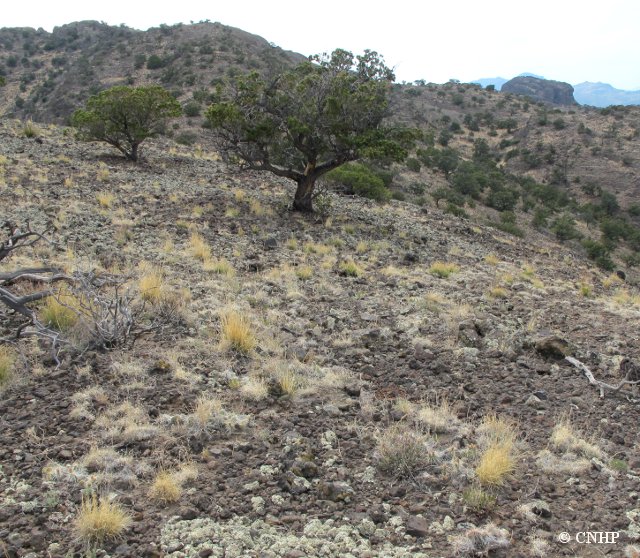
As Renée tells it: "As we approached our location everything started coming into focus and we started finding Aletes and seeing the striking views of volcanic cliffs and domes that were prevalent in the 1997 photo. When we saw the same dead pinyon pine from the photo, we knew we had relocated this non-descript location. The day was wearing on, so we weren't able to fine tune our exact location before snapping a few photos, but in spite of this we did get close enough to document the change, or really lack of change, since 1997. The original photo, judging by the shadows, was taken on a clear morning and our 2011 photo was taken on a hazy afternoon, due to nearby fires. In spite of the less than precise match we can still say something about the persistence of live and dead plants."

Reviewing the foreground, in front of the pinyon pines (both dead and alive), of the photos below, we can see that, in the relatively wet year of 1997, Aletes (the little green clumps) were common. In contrast, 2011 has been very dry in the Valley, reducing the cover and density of forbs, including Aletes. Drought tolerant grasses (all native) are a lot more noticeable in 2011 than in 1997. The live pinyon trees also haven't changed much in fourteen years.

1997 - view from the dead pinyon

2011 - still dead!
1997 - live pinyons

2011 - there they are to this day.

The low moisture environment of the San Juan foothills is a place where plants grow slowly and decomposition is even slower. Aletes is surviving the drought but fruit production was hardly evident in 2011.


Aletes lithophila hanging on in the 21st century.

Now that we know the precise location of the 1997 photo, perhaps
Renée can go back in a wetter year and hopefully see a vibrant Aletes population once again. Renée and Mindy went on from this spot to survey the State Land Board lands and located three new populations of Aletes lithophila.

CNHP has a plethora of old slides that should be scanned in while we still have the technology. If you would like to volunteer with CNHP to help us archive our old and aging slides, please contact Renée.

Friday, July 8, 2011

Adopt-a-rare-plant success


Earlier this year, a cooperative effort between the Colorado Native Plant Society, Denver Botanic Gardens and the Colorado Natural Heritage Program re-launched the Adopt-a-Rare-Plant program. This volunteer effort is aimed at revisiting “historical” locations of Colorado rare plants that have not been observed for 20 years or more. More than 30 people took part in training in March, and now reports are beginning to come in from their efforts. Ann Henson and Karen Hunter recently sent us some photos from their search for the Cathedral Bluffs meadow rue (Thalictrum heliophilum).


Two views of Cathedral Bluffs- what a panorama!


A couple of portraits of the adopted plant - you'd probably look a little scraggly too if you lived here.

 Yikes! It is a bit steep - time for botany by binocular?

Ann recording data.

 Karen searching - now where was that plant?

 The intrepid searchers back at camp, with a little light reading 
(Colorado Flora: Western Slope). 
Yes, I think I can see the plant from here.

Well done Ann and Karen!


Tuesday, June 28, 2011

New National Natural Landmark

Earlier this month, Secretary of the Interior Ken Salazar designated six new national natural landmark, including the Hanging Lake site in Garfield County. CNHP provided the National Park Service with the evaluation of this site that resulted in the designation. Read the NPS press release here.

 View of the lake from above. CNHP photo by J.B. Bell

Hanging Lake is a unique example within the Southern Rocky Mountains of a lake formed by travertine deposition, and supports one of the best examples of a hanging-garden plant community in the region. The site is also one of the larger and least altered travertine systems in the area, where natural geologic and hydrologic processes continue to operate as they have done throughout the history of the lake.


Tuesday, June 21, 2011

Two new species in Denver Botanic Gardens herbaria

We wanted to share the exciting (to botany nerds like us) news that specimens for two species new to science are now at the Denver Botanic Gardens herbaria. Herbaria are a valuable resource to botanists and mycologists for help in identifying species of plants and fungi and documenting where they have been found.

A brand-new species of mushroom, Smithiomyces crocodilinus, was found during the Soapstone Prairie BioBlitz that CNHP staff participated in back in 2009.

And a new wildflower species that was first discovered at Lone Mesa State Park also in 2009, has now been named Packera mancosana and its type specimen is available to visitors of the Denver Botanic Gardens Kalmbach Herbarium.

-------------------

On an unrelated note, we have now implemented Blogger's mobile device template for the CNHP Blog. If you use a mobile device to read our blog, posts will hopefully now be easier to read. Let us know if you have any feedback on the change!

Thursday, June 16, 2011

New online data submission forms

The Colorado Natural Heritage Program tracks and ranks Colorado's rare and imperiled species and habitats, and provides information and expertise on these topics to promote the conservation of Colorado's valuable biological resources.   Data maintained in our central tracking database (BIOTICS) are an integral part of the Natural Heritage Network and play a role in ongoing research at CSU. These data reflect the observations of many scientists and institutions and provide a record of the current state of knowledge of Colorado's biodiversity.

These data are acquired from various sources, including you! If you have field survey data that you would like to submit for inclusion in BIOTICS, we now have online data submission forms to supplement the hard-copy field forms, both of which can be accessed here.  We hope these web forms make it easier for you to submit your data to us and, as always, we welcome any feedback about how the forms work for you.

Tuesday, June 14, 2011

A Special Guest at CNHP


Dr. Vinod Mathur, Dean of the Wildlife Institute of India, visited CNHP last week. 

Dr. Mathur and CNHP Director Dave Anderson.

Dr. Mathur stopped at CSU to visit partners in the Warner College of Natural Resources on his way back to India from a conference in Pueblo, Mexico.  While he was here, many of us got a chance to meet Dr. Mathur.  It was interesting to learn that, despite the geographic distance between us, there are so many similarities between the conservation challenges and priorities in India and Colorado.  Noxious weeds, population growth, and limited natural resources are key concerns for both of our institutions, and the solutions often cross borders and continents!  

Dr. Mathur’s son, Vinamra, will be doing an internship with us this summer for about 2 months.  For his first month he will be a crew member on our GLORIA (Global Observation Research Initiative in Alpine Environments) project which will establish plots in alpine areas of Rocky Mountain and Yellowstone National Parks.  Vinamra will then help with other projects including wetland assessments, Jefferson County biological inventory, and our work at the U.S. Air Force Academy.  We are excited to work with Vinamra this summer!

Thursday, June 9, 2011

Ecological Systems: Colorado Plateau Pinyon-Juniper


In Colorado, pinyon-juniper ecological systems may occur as shrublands or woodlands, or as sparsely vegetated bedrock canyon and tableland systems. This is the characteristic system of Colorado’s western mesas and valleys, where it is typically found at lower elevations (ranging from 4,900 - 8,000 ft) on dry mountains and foothills. Colorado Plateau Pinyon-Juniper stands may vary considerably in appearance and composition, depending on altitude and geographic location. Pinyon pine and/or Utah juniper form the canopy. Juniper is often more abundant at the lower elevations, while pinyon pine tends to be more abundant at the higher elevations. Rocky Mountain juniper may replace or co-dominate with Utah juniper at higher elevations. These woodlands often occur in a mosaic with other systems, including sagebrush, oak, and semi-desert shrublands. The understory is highly variable, and may be shrubby, grassy, sparsely vegetated, or rocky. Severe climatic events occurring during the growing season, such as frosts and drought, are thought to limit the distribution of pinyon-juniper systems to the relatively narrow altitudinal belts that they occupy.


Pinyon-juniper woodlands are influenced by climate, grazing, fires, tree harvest, and insect-pathogen outbreaks. Since the late 1800s, distribution and density of pinyon and juniper and the accompanying native understory has been significantly altered by changing fire frequency, grazing patterns, and climate cycles. In many places, these two tree species, especially juniper, have encroached on adjacent shrublands and grasslands, changing the habitats available to wildlife, as well as the forage available to domestic cattle. In this system, fire acts to open stands, increase diversity and productivity in understory species, and create a mosaic of stands of different sizes and ages across the landscape while maintaining the boundary between woodlands and adjacent shrubs or grasslands. 


These woodlands are used by many common mammal species, including several bat species, desert and Nuttall’s cottontails, Mexican woodrats, rock squirrels, pinyon and deer mice, gray foxes, mule deer, and mountain lions. Common bird species include the pinyon jay, western scrub jay, turkey, chipping sparrow. A number of reptiles are characteristic, including the collared lizard, plateau lizard, and tree lizard. Pinyon-juniper is the third most important habitat in the state for Colorado’s rare plants. This is also an important habitat for birds, including the  Gray Vireo, one of Colorado's rare birds, and the black-throated gray warbler. Rare reptiles include the long-nosed leopard lizard.

Colorado Plateau pinyon-juniper covers nearly 5 million acres in western Colorado. Ownership is predominantly federal, mostly under the management of the Bureau of Land Management. Pinyon-juniper ecological systems have declined in both extent and quality compared to historic norms, although there are a number of very large patches remaining.  Threats include urban development, recreation (especially motorized recreation), invasive species (most notably an increase in cheatgrass in the understory, which has led to increasing fire ignitions), and energy development.  

Overall biodiversity, threat, and protection status scores for
Colorado Plateau Pinyon-Juniper in Colorado.

 A "windrose" graph depicting Colorado Plateau Pinyon-Juniper status for individual scoring factors.

Tuesday, June 7, 2011

Willhite Ranch Monitoring

By Amber Provinzano
CNHP Botany Technician

The Willhite Ranch conservation easement, near Holly in southeast Colorado, was established for the protection of Lesser Prairie Chickens, but also benefits an array of other animal and plant species, including Cassin’s sparrows and ornate box turtles (Terrapene ornata ornata). CNHP ecologist Renée Rondeau has collected data yearly since 2009 to set up baseline information. This year, as my first official field work assignment, I accompanied Renée to the ranch to gather data on the sandsage prairies that lie within the boundaries of the easement.

The Welcoming Committee - best greeters ever!

I quickly learned the difference between a “breeze” and a full force “wind” in the southeastern part of Colorado, as 20 mph winds are more of a breeze compared to the 45 mph winds we worked in towards the later part of the afternoons. Despite my aversion to wind, the time out in the field and away from the office is a contributing factor of my choosing to pursue a degree in wildlife biology.

Over the 36 points where we gathered data and took photos on the vegetation composition, we did not see any prairie chickens. Avian life we did observe included Cassin’s sparrows, raptors, and Colorado’s state bird, the Lark Bunting, which Renee said was in abundance as compared to the previous years. It was my hope to find a living ornate box turtle but instead we discovered five empty and broken shells, the cause of death remains a mystery. This year was dubbed The Year of the Lark Bunting and Dead Box Turtle.

An ex-box turtle, bleached from the sun.

Nothing says "Old West" like skulls on the prairie.

We saw four snakes; one baby massasauaga (Sistrurus catenatus) that Renée and I shooed off of the road, an adult western rattlesnake who buzzed me when I got too close trying to take a photo, a racer that Renée demonstrated how to successfully catch and was the most docile snake I’d ever seen in the wild, and one dead coachwhip (Masticophis flagellum) that we weren’t able to shoo off of the road in time. Among the legged species we observed, we encountered jack rabbits, lesser earless lizards, and mule deer. I was also thrilled to see so many baby cows in the pastures- hard to find another mammal out there that’s cuter than a calf with big ears and wobbly legs.

 Our friend the racer (Coluber constrictor).

Renée holding the docile racer.

Me (Amber), making pals with the racer. We let it go immediately after the photo shoot.

Western rattlesnake (Crotalus viridis) heading in the right direction (= away from me).

It was interesting to come across big pieces of junk that had been thrown out in the middle of nowhere. The wind had filled the insides of old refrigerators and stoves with sand, and I would be curious to know if those junk pieces will ever be completely buried by the sand blowing through the prairie.

I suppose snakes or other critters may be living in these things. Still, the prairie doesn't really need artificial reef habitat.


What do you suppose those round things are by the duck's belly? Canatloupe?

It does indeed seem to be "Everlasting", if not ever-functioning.


Willhite Ranch proved to be a great place to start the field season and learn about life on the prairie from the expert Renée. I’m excited to spend more time out in the field this summer with all of the knowledgeable CNHP staff.

Barrel cactus in bloom.